
Iwane Nursery Schools
- At July 27, 2016
- By anneblog
- In Annes Letters
 0
0
Dear Family and Friends,
In a previous essay I told you about Iwate Prefecture and several remarkable people there.This time I would like to introduce work being done in that area by Caritas Switzerland. There were other groups involved in these projects, too: Taiwan Red Cross through the Japanese Red Cross (for the Kirikiri Nursery), the Swiss Red Cross through Caritas Switzerland, Swiss Solidarity, and Catholic Relief Services, which is the American Caritas. But the woman I went with is involved with Caritas Switzerland, so that is where my focus will be.
As you probably know, Caritas Internationalis is a Roman Catholic organization devoted to “relief, development, and social service work”. This confederation has 165 branches, making it one of the largest humanitarian networks in the world. Its main headquarters are in Vatican City. Although it is Roman Catholic based, it does not proselytize or deny assistance because of religious belief. Each of the 165 branches works under the large umbrella of Caritas Internationalis, but is independent of the others. For example, Caritas Japan has a different agenda in Tohoku from Caritas Switzerland. Although both are doing work in the same areas, they do not interfere with one another. To be specific, on this Tohoku project, which is a one-time relief service, Caritas Switzerland mainly concerns itself with physical rebuilding, whereas Caritas Japan focuses mainly on the emotional well being of 03/11 survivors.
A former student, now friend, Akiko Wako, works for Caritas Switzerland in Iwate. Because of my interest in what is happening in Tohoku, she agreed to escort me to Kawaishi City, where she has been heavily involved in rebuilding the four nursery schools under Caritas Switzerland’s wing.
As we came to the city, we were met by an ongoing parade of trucks and clusters of backhoes. They were literally raising the level of ground that the coastal communities will stand on.
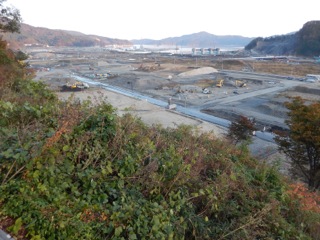
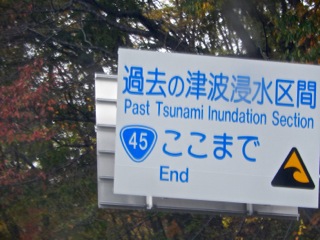
We also saw signs all along the hilly main road indicating how far the tsunami had come. So, the atmosphere was one of great busy-ness and of renewal. It felt hopeful.
Caritas Switzerland decided to focus its work on rebuilding four nursery schools. Why, you might think, would they put their effort into those places, when so much other fundamental work seemed more pressing? One answer is that Caritas Switzerland, like Japan in general, thinks long term. If children have good care, they reason, then young families will be more likely to stay. And indeed, the drain of people from coastal areas has been alarming. Likewise, if formative years are secure and love-filled, then children will have a greater chance of having secure lives. And in the long term, that will make for a more stable society.
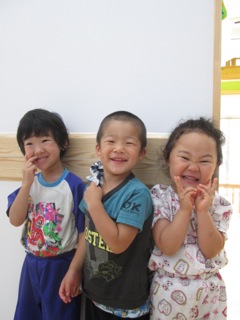
(photo copyright Caritas Switzerland, used with permission)
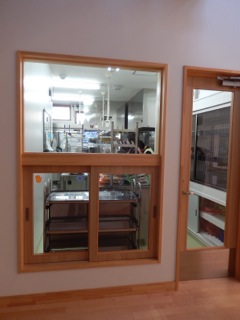
The first nursery school we visited was in Unosumai-cho district of Kamaishi City. It was gorgeous. It had a long wooden corridor with brightly lit rooms, one for each age, off each side. There were windows everywhere, not only for light to enter, but also to allow the youngsters to peer into places like the kitchen or the main playroom.

The building also had skylights on the roof, plus solar and wind power devices. There was a digital chart showing how the natural energy was being used. It also had well water for the garden and for use in emergencies. And there was a vegetable garden that produced fresh food for the school’s meals. It also gave the children a chance to get their hands in the earth and to be part of the life-giving process of farming.
The building adjacent to the main nursery served as an evacuation center. In Japan schools are used by the entire community in times of emergency. Likewise, this particular school hosted community events throughout the year. And one room was open to the public from 9 a.m. to 4 p.m. daily so any child up to age 6 could come and play, as long as they were accompanied by an adult.
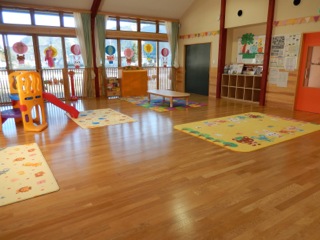
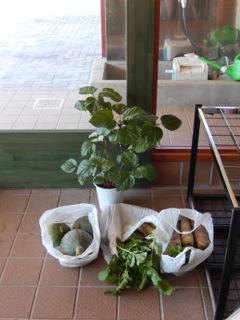
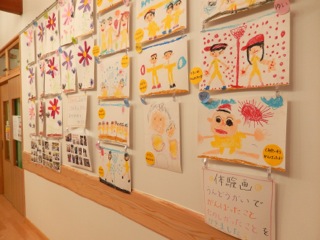
The school itself was not only physically stunning. It was also very welcoming and warm. For example, when we arrived, there were a few bags of vegetables that parents had brought as an offering. And the walls were covered with children’s work.
The ratio of teachers to youngsters was very low: about 1 to 3. As for the infants, there were 4 teachers for the 9 babies.
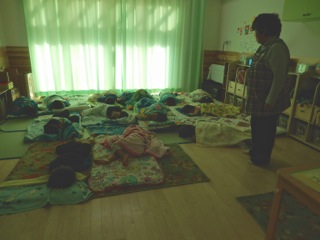
Before this facility was open, this nursery cared for its children in a community center. Other nursery schools were housed in buildings provided by UNICEF or by the Japanese government. The community really cares about the future of its children. And the efforts it now makes on its youngsters’ behalf will surely bear fruit in the years to come.
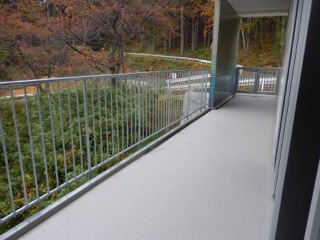
The second place we visited was called Kirikiri Nursery. It was in the Otsuchi-cho district of Kamaishi City. Since it was built on an exceedingly slim edge of newly leveled land, it had two storeys instead of only one. It also had what looked like a veranda on both sides of the building. They were actually easily accessible escape routes for times of emergency.
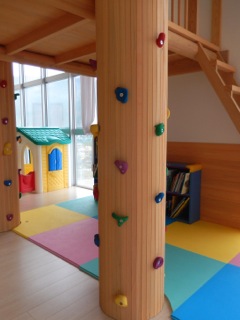
Upstairs was a large playroom. It had an inviting structure for climbing. “Kids started getting fat when they were trapped in evacuation centers and temporary housing,” our guide told us. “So, this is to encourage them to move their bodies as they should: to run and jump, to climb and play.”
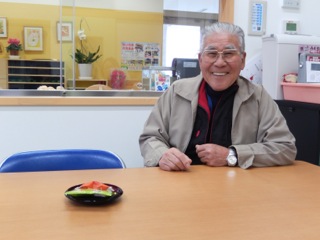
The gentleman who followed along as we toured Kirikiri Nursery was Touemon Azumaya San. He was a jolly 81-year-old man who oversaw this nursery.
After our tour of the facility, he pointed out where the old school had stood for about 50 years. He also indicated where their temporary headquarters had been until a few months ago. And he even showed us the garden on his relative’s property where he grew vegetables for the school lunches.
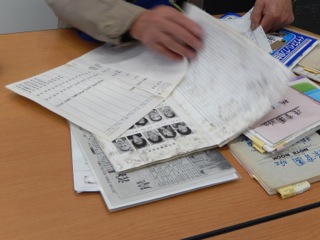
When we sat down for tea after our tour, Azumaya San brought out hand-written records he had methodically kept for years. Miraculously they had survived the tsunami. He whipped through every page, explaining his detailed notes: what days had been sunny, what had been served for meals, which teachers had been ill.
When he realized our genuine interest, he loosened up and began telling stories further afield. He talked of the war. (He was 10 then). He confessed that he had never finished school, but had gone north to Hokkaido to find work. He told us about the various jobs he had had, how he came back to Kamaishi, married and raised a family. He showed us a photo of his taisho koto musical group. And seemingly in passing, he said, “ This is the last photo taken of my wife and me together. She drowned in the tsunami.” No one in the room had known about his wife. Everyone was speechless, to say the least. Such stoic silence is the nature of Tohoku people. “We don’t want to bother people with our problems,” they explain.
But then his story seamlessly continued. “I love these kids.”

(photo copyright Caritas Switzerland, used with permission)
“We have to give them the best we can. How else can we create the future that we wish for them? And for the world as a whole as well?”
Love,
Anne
Iwate, Three Remarkable People
- At July 27, 2016
- By anneblog
- In Annes Letters
- 0
Dear Family and Friends,
Iwate is the prefecture north of Miyagi. Even though I had visited tsunami-affected areas in both Fukushima and my own prefecture, I had never been further afield. Of course, I have a keen interest in what is evolving in this whole region. So recently a friend, Akiko Wako, and I headed north to find out what we could about Iwate.
Lovely, rural Iwate has long been left by the wayside, as Japan barges ahead with cutting-edge technology, scientific research, and gadgets cute beyond imagination. But that “backwardness” means Iwate keeps such values as sharing traditional stories, community solidarity, and working for the good of the whole.

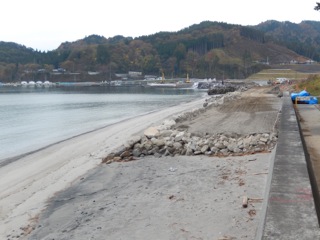
Since then, a lot of work has gone into clearing up and rebuilding. The same is true in other places, too, but there is a difference. Fukushima is still hindered by the ongoing nuclear problem. And in some places, Miyagi fishermen have been fighting the exceedingly high government-proposed tsunami wall. Those men, who know the sea well, believe that monstrous intrusion will interfere with tidal currents and fish runs.
But in Iwate, at least in Kamaishi City in the south, people seem to be more compliant. The new tsunami wall is a given, and the raising of the entire inhabitable area is progressing nicely. Actually, the feeling of solid progress we felt there may also have been because Akiko and I talked to people who were more or less getting back on their feet. They were not to where they had before the disaster, but they did have their businesses running, and they still had dreams.
(However, friends who offer stress-reduction workshops in orphanages further north say that the stress levels among employees there are higher than that of firemen.)
Likewise, Kamaishi City has a long history of iron and steel manufacturing. The factory buildings were sturdy enough to withstand much of the impact of the earthquake and tsunami. So, the economy in that town was able to catch hold sooner than in other parts of Tohoku.
Land is acutely scarce here. And that makes housing a crucial issue. So, everyone, from individuals to government officials, has been working to find solutions to this very critical problem. One choice has been to raise the entire level of the land by several meters. As that phenomenal task is being implemented, the damaged parts of the city are slowly being rebuilt on that newly made higher ground.

Besides raising the land, nearby mountains are being denuded of trees and leveled on top. The hope is that these will become areas for small communities. By doing this, hopefully, people will stay in the area, and maybe even come back. So many have left already.
On this trip to Iwate, Akiko and I were privileged to talk to several impressive individuals. The first was a man named Kikuta San.


“This place used to be known for its beautiful beaches,” he told us. “People came all the way from Tokyo or further south for a relaxing vacation. That isn’t happening now, of course. But we’re all hoping things will come round and we’ll have reliable businesses again.”
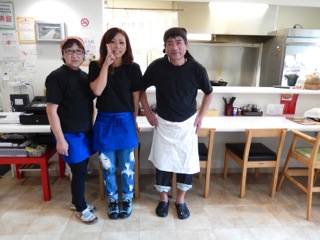
The next person we chatted with was a woman named Matsuda San. She owned and ran a small coffee shop. Her establishment was in a converted “kura”. A “kura” is a traditional stone storage building associated with a wealthy person’s home. It was separated from the main house, which was made of wood. Family heirlooms, such as fine kimonos, jewelry, and rare china, were protected from fire or flooding by being kept in a “kura”.


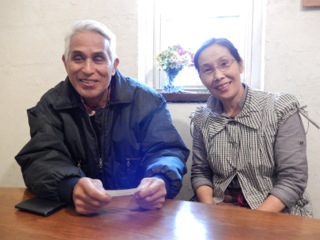
The third person – or rather persons – we met were a husband and wife team.
Love,
Anne
Stories from Tohoku
- At July 27, 2016
- By anneblog
- In Annes Letters
- 0
Dear Family and Friends,
Recently a unique group of film makers came to Sendai. They were special because they were Japanese-Americans. When the March 11, 2011 earthquake hit, like thousands of others worldwide, second and third generation Japanese-Americans felt a strong urge to help. After the 1995 Kobe earthquake, the Japanese American Friendship Association was able to raise $600,000 as aid money. Since the Tohoku disaster was so much larger, the group hoped to get a million dollars. Thanks to extensive TV coverage and the Internet, however, within a few weeks they had raised over four million dollars. That huge outpouring of concern and financial support revealed how deeply connected Japanese-Americans still are to the land of their Asian ancestry.
The Japanese American Friendship Group was so impressed by how well the Tohoku survivors have been dealing with their tragedy that it decided to make a documentary. The result was Stories from Tohoku.

In May 2011, a few weeks after the disaster, Darrell Miho, a photo-journalist who was part of the documentary team, went to Minami Sanriku Cho, in northern Miyagi Prefecture.

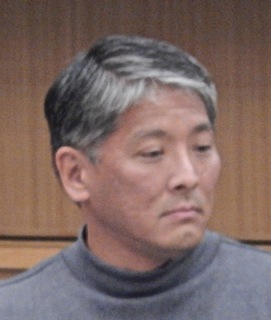
Another third generation Japanese-American, Paul Terasaki, is the founder and director of the medically focused Terasaki Foundation in Los Angeles. After 03/11 Dr. Terasaki began offering scholarships to Japanese-American students for a two-week volunteer tour to devastated regions in Tohoku. He wisely knew that direct experience would have a much greater impact than TV images. And indeed, the young people interviewed in Stories from Tohoku all mentioned how much the trip had changed their outlook. “We saw the damage and ongoing suffering. We witnessed the people’s courage and resilience. We realize that fortitude is part of our heritage. We are proud of that. And we also want to help in every way we can.” The Terasaki Foundation is still sending students to this region.
In the USA the documentary has been well received in film festivals in Los Angeles, San Francisco, New York, and Honolulu. Besides documenting the years since the disaster, it also reminds people that the crisis is not yet over. Survivors are still crowded into small temporary housing units. As one example, Imai Sensei of Yomawari homeless group in Sendai told me that one family had so many living in such cramped space that the father opted to become homeless and live on the street in order to allow room for his family in the temporary quarters provided by the government. But with typical “gaman” spirit, local residents say, “We do the best we can. It is not easy, but we get by.”

There was a panel discussion after the showing of the documentary in Sendai. The do-director and co-producer, Dianne Fukami, another co-producer, Debra Nakatomi, and Darrel Miho were there. They told us how meaningful it had been to make the film. And they hoped it would be shown in more places in both Japan and the USA. Of course, they wanted people to continue giving much needed support.
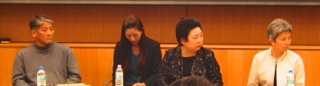
As a closing remark Darrel Miho said, “When I was a kid growing up in America, I never understood what my parents were trying to teach me. It didn’t make sense to me. They stressed “gaman”; that is, never give up, no matter how tough things get. They also never let me complain. And they sternly taught me to always show respect to others.
“When I got to Tohoku and saw how the people were behaving – uniting as a team, helping one another, never complaining, not giving up even if they had lost everything – I suddenly understood what my parents had tried so hard to instill in me. It’s all happening right here. And now I can see and experience its incredible beauty. I guess in a way you could say that coming to Tohoku at this significant time has allowed me to finally come home to myself.

“Whenever I leave this area, people say, ‘Come back and see us. And please don’t forget us.’ I guess that’s the core message of this documentary. Come see for yourself. And never forget those still struggling to survive.”

Love,
Anne
Ishikawa Sensei and Okudaira Sensei
- At July 27, 2016
- By anneblog
- In Annes Letters
- 0
Dear Family and Friends,
The other day I had the privilege of meeting two doctors who are doing very significant work here in Tohoku.


“Dr. Ishikawa, how have you been able to stay in such a complex field for so long? I mean, treating alcoholics is not like curing a cold, where there is a beginning and an end. What keeps you going day in and day out, especially when your work is filled with so many setbacks, so many disappointments, and with no guarantee of success?”
Dr. Ishikawa took a deep breath and then began to unfold his heart of wisdom and of profound love.

“But now after thousands of cases and years of experience, I see how much my outlook has changed. First of all, and most importantly, I realize I am not the one who cures. And surely I am far from alone! Dealing with alcoholics means teamwork: the patient, of course, but also the family, the entire hospital staff – and that includes everyone from my colleagues at the top, like Dr. Okudaira here, all the way through to the cleaning people – and then myself. And of course, Kami (Gods) are an integral part of the process, too.

“I no longer see myself as the center, but rather as a coordinator. I link all the other members of the team. I try to match the right person, at the right time, for the right care for each of our patients. Needs change daily, even hourly, so the work is never ending. But I like to serve from behind, so people develop their own power in the treatment process. Of course, respect for all is paramount.

“And indeed, treating an alcoholic is a process. The ongoing stages are what I focus on now. Did you know there are specific stages in the patient’s attitude? After the initial denial and blaming comes ‘I must go into treatment. I must try to stop drinking for my family and for others. If I don’t, they will be disappointed and angry with me.’
“That step is very important, but it is only the beginning. Here the motivation is external, so it can never be permanent. But eventually the next phase emerges. And that is, “I really want to break this habit.” Here, as you can see, the incentive is from within the patient. This stage takes incredible courage to work with and through. The tug of war between the desire to stop and the power of the addiction can be fierce, almost overwhelming. But again, with the support of the family and the medical team, the person may eventually overcome his or her incessant need to drink.

“But even that glorious success is only one step in the long, ongoing healing process. The next phase comes when the patient realizes, ‘I no longer even want to drink. I am OK without the bottle.’
“These stages parallel the inner journey of the patient as well. At the start of therapy, the person suffering can only see blackness. All memories, all present thoughts, and all future images are a vast endless ‘Dark Night of the Soul’. The sense of hopelessness and of despair are fathomless.
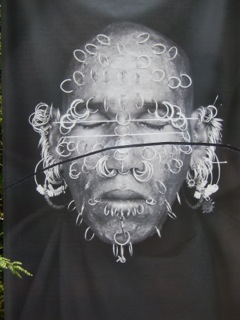


Our conversation naturally drifted to other addictions. “There is a huge gambling problem here in Japan,” Dr. Ishikawa continued. “Pachinko parlors are making billions. They are so clever at luring people into their poisonous webs. And it is tremendously difficult to extricate yourself from them. Curiously, brain scans show that when people are gambling, their brains seem to register less excitement than they would normally. That, of course, means that they need more and more stimulus to feel much of anything at all. And with that, they are hooked.
“Another alarming addiction is kids hooked on computer games. It is truly frightening to see how many are swept into that vortex of compulsive entertainment.
“How do you treat youngsters with such problems,” I queried. “Is it the same way as with alcoholics?”
“Yes and no. Young people’s development and needs can be very different from those of adults. But no matter what we are treating, we always take a team approach. And in each case we try to work with each particular patient according to his or her specific needs. Of course, working with parents is essential when treating youngsters.
“Helsinki has an excellent system to treat substance abuse. It is a three-year program: two weeks as in inpatient, three as an outpatient. This process repeats itself for the full three years. The success rate of non-returnees is very high.
“I would really love to see a similar program here in Japan. But the patients in Finland have to pay the entire fee in advance. That would be the case here, too. Of course, considering the overall cost of treatment, the amount is reasonable. But most people gasp at the expense, so we have not been able to get this kind of rehabilitation program off the ground here. Not yet. But who knows what the future might bring?”
As a closing comment, Dr. Ishikawa talked about dependency and independence. He said that when people dependent on others or on alcohol, they might be aware of three or maybe four people who are supporting them. But when they begin to stand on their own two feet and feel more independent – of others and of alcohol – their awareness changes. They begin to see that well over a hundred people are there supporting them, and have been all along.”

The Second Charity Walk
- At July 27, 2016
- By anneblog
- In Annes Letters
- 0
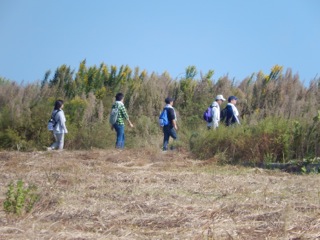
Last year I witnessed the start of a charity walk. It was sponsored by an NGO that goes by the same name, Charity Walk. This year they held a second such event, which I also was privileged to record.
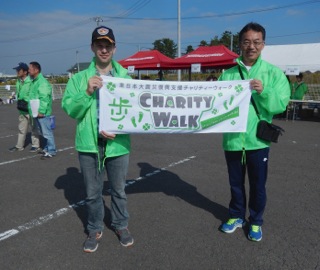


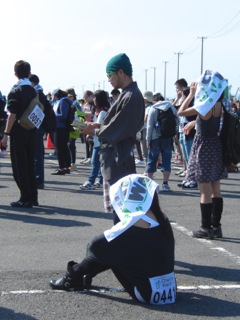
Another reason this year was different was one member of the volunteer planning team was a foreigner, Justin Velgus. He is devoted to this area, and therefore wanted to contribute all he could. Among many other duties, he translated the website and fliers for this event. He also drummed up a few other non-nationals to participate. “I’ll be here next year, too,” he told me. “I think it’s important to give where I can. That way I feel more rooted to this place. I want Sendai to be my long term home, and this is one way to help make that happen.”
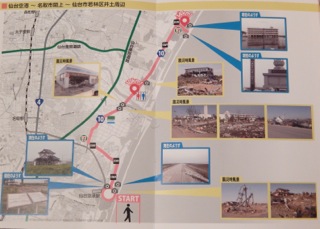
Next year they may make the program shorter, even as few as five kilometers. That might encourage families with kids and also oldsters to join, too. It is wonderful listening to their evolving ideas. In fact, the Charity Walk itself seems to parallel the ongoing changes in this entire area.
Love,
Anne
The Next Step
- At July 27, 2016
- By anneblog
- In Annes Letters
- 0
Dear Family and Friends,
There is an interesting new development happening now. Recently foreigners are coming to this area to report on the progress being made. Of course, professional newscasters have been here since the disaster, but now ordinary foreign citizens are coming armored with cameras and microphones. They are conducting interviews, mostly about how people are getting on in their daily lives. In Sendai these interested individuals can be found near the main train station or in areas with a lot of human activity.
Others go further afield. One man, Austin Auger II from California, for example, went to the coastal areas of Miyagi Prefecture. He interviewed locals to find out about their lives now. The survivors talked about the “before, during, and after” of their lives. Austin wants to stress the positive, so is focusing on what was bringing people happiness and meaning as they work to reestablish themselves. His documentary should come out within a year.
Another Californian, a fourth generation Japanese American named Nana Kaneko, is here to do research on “Music Activities in Tsunami-Hit Places.” This, of course, explores the emotional well being of survivors and ways they are using to uplift their spirits. Nana herself is an ethnomusicologist, currently spending a year in Japan doing research for her PhD.

Thinking of the arts, ever since the earthquake, a local man here in Sendai, Hiroshige Kagawa, has been painting enormous pieces depicting devastated buildings. His works are so large and impressive that some of them have been used as backdrops for dance performances.


These kinds of research and recordings are very helpful. They shed light on people’s determination to create meaningful lives, peppered with activities that alleviate stress and bring joy.
There are other dimensions to the picture, too, of course. The other day, for example, I had the privilege of going to Koriyama to interview a nursing student. Koriyama is an hour south of Fukushima City by bus and 50 kilometers from the nuclear power station. It is in Fukushima Prefecture, but is not on the coast.
This young nursing-hopeful, Hikaru, has lived in Koriyama all her life. Her home collapsed from the violence of the earthquake, so her family lived in evacuation centers for five weeks. They were very fortunate to be able to move directly from there to an empty house in their old neighborhood. Compared to people in other areas, five weeks is record time. “There weren’t so many damaged houses in Koriyama,” Hikaru explained to me. “And there were a lot fewer people in evacuation sites as well.”
Hikaru is the one whose brother, now age 12, developed a cyst on his thyroid gland soon after the nuclear problem began. This sort of trouble has not been reported openly. Since no official statement has been made public, no one knows who has these unseen troubles or how extensive they are. However, since she works in hospitals, both in Koriyama and Fukushima, Hikaru has learned a lot about what is going on.
For example, there has been an increase in thyroid cysts. In fact, her brother has developed a second one. Neither is cancerous so far, but he is being closely watched. Hikaru explained that immediately after the meltdown, winds brought radiation into the Koriyama area. People were not aware of the danger, so lots of kids played outside everyday. Her brother was one of them. The government has cleared off the top levels of the earth in all open spaces. And since then, toxicity has gone down to safe levels. Koriyama is doing better than Fukushima City because it is basically an industrial city, whereas Fukushima is more agricultural. Plus it does not carry its companion city’s infamous name.
On the surface people in Koriyama seem to be living normal lives. The streets are clean and attractive. They have many busy shops. There is no sign of rebuilding. In fact, there is no hint of even needing to rebuild.


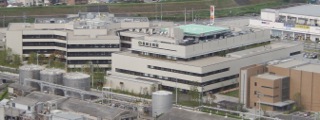
Next to the station is the “Tallest Planetarium in the World”, written up in the Guinness Book of World Records to prove it. We went to the top of the building to have a look across the city. It was much more spread out than I had expected. Behind the railway station was the industrial zone. In front was the area for with offices and shops. Even though few builds collapsed in the earthquake, we did see two vacant ones. They had been hospitals. New ones have been built nearby.


Love,
Anne
Profound Changes
- At July 27, 2016
- By anneblog
- In Annes Letters
- 0
Dear Family and Friends,
There is a very beautiful YouTube that was made by survivors in Ishinomaki City several months after the tragedy of 03/11. That video ends with the image of a mother holding her baby. The child was born the same day that so many others lost their lives or their livelihoods.
(In order to watch this YouTube, please scroll down to the second image, which is still open for viewing.)
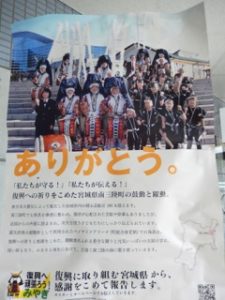
Over the years since our hearts and psyches were severed so deeply, posters expressing thanks have begun to appear all over the Tohoku region. Most of these photos show towns’ folks clustered together with beaming smiles. They want to show how far they have come and how grateful they are for the help and support they have received from so many.
Actually, there is no one here was has not been changed by the shock and consequences of 03/11. Everyone still talks about how the events of that time changed them in very profound, often not overt, ways. People live with greater uncertainty and vulnerability now. And they have a much deeper awareness of what really matters to them.
Of course, people still work incredibly hard, in some ways more than ever, but now there is a sense that life is more than total commitment to the job. People are taking more time for their families. They seem to enjoy their kids more. And it is not uncommon to see fathers taking their children to school or chatting with them as they walk down the street hand-in-hand. They obviously enjoy spending time with their young ones.
Even young people, previously notorious for their immaturity and superficiality, have a sadness and depth, even a kind of wisdom that only life experience can carve into their psyches and souls. Everyone here now knows we are alive because of all those who have helped us.
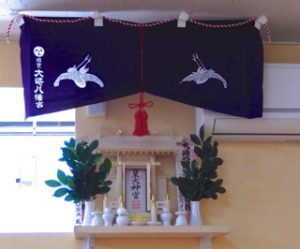
“I used to pray to only the Shinto gods,” he told me. “I have an altar both at home and in my company. Everyday I would bow before it, clap to wake up the gods, and then pray.”
I asked him to explain further. He said, “There are the four cardinal directions, of course. But there are also the gods above us, and the ones below us. They all form a circle of protection around us. I bow to each of them, and then I review my life, thanking everyone who has ever helped me. I have had so many mentors. I am so blessed. In fact, I guess you could say my god is the God of Gratitude.”
Anne




 PastedGraphic-1.pdf
Revisiting Sendai Airport Forest Park, August 2014
- At July 27, 2016
- By anneblog
- In Annes Letters
- 0
Dear Family and Friends,
As you well know, the 03/11 tsunami hit the Sendai Airport with a vengeance. It plowed in, ripping its way over fields and forests, and then through human settlements before completely encircling and disabling the airport.

But that was three and a half years ago. And things are very different now. In fact, that area is one of the most forward moving places in this region. It is also where I went a few months ago, along with 6000 other enthusiastic souls, to plant trees.
Having an emotional interest in that infant forest in particular, and in the devastated coastal areas in general, every few weeks I like to return there to see how things are progressing. This time, though, rather than being with thousands of diligent, well meaning folks, I was pretty much alone. Of course, there were construction trucks plying back and forth, a few solitary fishermen, and even an occasional tourist. But otherwise I had the place to myself. I much preferred it that way. The essence of the atmosphere was more readily available, allowing the land, the sea, and the breezes to tell their stories more directly and purely.

The next thing I came to was a building, even now standing, where the army had parked its vehicles during the clean up operations. Now the place is pretty much deserted. But an enterprising farmer had turned his patch of land next to it into an inexpensive long-term parking lot.


Then came the Shinto shrine and teeny clump of pine trees that had withstood the tsunami because of being on a small rise of land. The Buddhist temple next to it had been rebuilt. The graves that were damaged have now been repaired, old stones lined up, and new ones stretching behind a large vegetable garden that another local farmer could not resist planting. And bordering the walkway were very moving handmade boards with words of encouragement on them.


From there I came upon the Suzuki house, a real landmark as the only shattered building left standing. It seems to be a permanent feature now since there is a sturdy sign in front of it. It displays “before, during, and after the tsunami” photos. It is a poignant reminder, not only of that infamous time, but also of the fragility of life itself. Even wealth, social standing, and strong confidence, all of which the Suzuki family had, cannot withstand the vicissitudes of time.


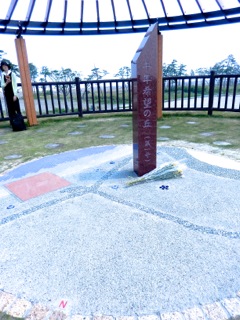
Despite being acutely aware of the uncertainties of life, the Japanese always build with a sense of long-lasting purpose. So behind that grand new seawall was the newly planted “Forest of a Million Trees”, or more poetically, “Hills with a Thousand Years of Hope Project”. In English that flattens out to “The Great Forest Wall Project”. The same idea, but very different sentiments.


As I headed back to the entrance, I came across a small clutch of volunteers. They had come all the way from Tokyo on a company project to help us here in Tohoku. They were weeding and planting a few trees as their gesture of support. “Our contribution is very small, but we want to help,” one woman explained to me.

Surrounding the human-planted grassy areas were marshlands, alive with birds, flowers, and tall reeds. They were a magnificent manifestation of Mother Nature’s constant renewal, appearing along side the tremendous human efforts to rebuild this once devastated area. The harmonious blending of the two, side by side, seemed to say that when we humans work in conjunction with Nature, even in all her fury, we will be able to make life more promising for all.

And finally, the prayer tower and bell were still there, waiting patiently for someone to sound their chime. I pulled the cord twice, bowed in prayer, and listened to the gong’s echo reverberating across the land and far out to sea.

Along the coast, there is a very silent, deep, and sacred feeling that seems to pervade the entire area. This profoundly wise and knowing presence seems to have nestled in, offering a sense of ongoing reassurance and loving care. Somehow that feeling gives a sense that this world and those that lie beyond are closely connected . . . very closely connected indeed.
Love,
Anne
Tanabata Inspiration
- At July 27, 2016
- By anneblog
- In Annes Letters
- 0
Asians are known to be hard working. They are also renown for their artistic achievements. Those two traits have been recorded in myths and folktales for centuries. One such story from long ago is the Tanabata. It weaves together the threads of several traditions, making a unified and touching whole.
The Tanabata legend actually comes from ancient China. It says that long ago there was a beautiful lady named Orihime, the Weaver Princess. This talented woman was not only a weaver, but also a seamstress. She loved taking pieces of her woven tapestries and putting them together to make unified patterns of outstanding beauty. With time this gracious lady became famous for her hard work and finely made clothes.
One day when she was diligently working, she looked up and saw an exceedingly handsome man wandering by. She immediately fell in love with him, an ox herder named Hikoboshi. Every day this stunning gentleman came into her view as he tended his exquisite beasts, the best and most famous in all the land.
Some versions of this story claim they were allowed to marry. Others say they became lovers. Whichever, they were so much in love that the heavens rang with their delight and pleasure.
In China the telling of this legend stresses the importance of working hard and of making efforts to improve one’s talents and skills. In Japan the message is similar, but the celebration of love is also emphasized. In addition, the Japanese have taken the original Chinese story and have woven in threads of Shinto belief.
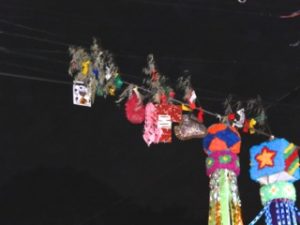
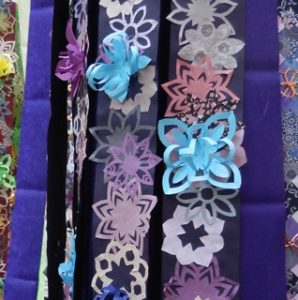
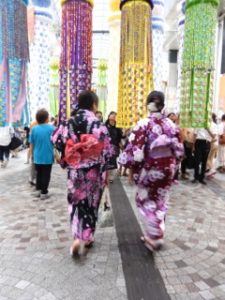
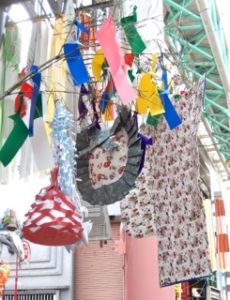
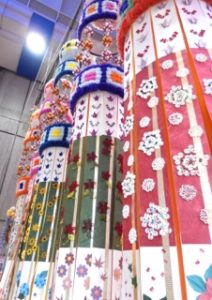
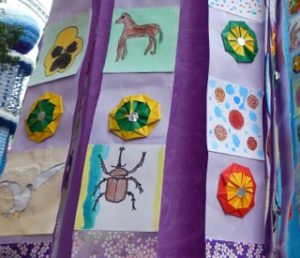
Tanabata decorations are made with long bamboo poles. They line the main streets, bowing low to graciously form arcades of beauty. Suspended from these supporting bamboo poles are symbolic origami figures. There are paper cranes, of course. They express the wish for the long life and health of one’s family. There is a fishing net, because Japan depends on the sea for its survival. Then comes a kimono, representing prosperity and good luck. And a purse is a reminder to save, and not spend frivolously. Surprisingly, there is even a trash bag. It tells us that we are responsible for keeping the world clean and our thoughts pure. Finally, there are “Tanzuku”, or slips of paper where people can write their wishes.
For over a thousands years Tanabata has been celebrated in Japan as a magnificent display of talent, handiwork, and beauty.
The same attitude is returning now. Since the 03/11 earthquake, Tanabata “Fukinagashi” designs have become more gorgeous and varied. This is done as a way to encourage people in their efforts to move forward. There is always respect for the past, which is the springboard for the present. So on the tips of the long bamboo poles, you can see the six original origami shapes: cranes, a fishing net, a kimono, a purse, a trash bag, and “Tanzuku” with messages written on them.
Now the long “Fukinagashi” streamers are imaginatively decorated in delightfully new and imaginative ways. The themes often reflect the shops near them. For example, during this year’s Tanabata, a sweet bean shop had vivid green steamers, a glasses store had eye exam charts, Fujisaki had displays of traditional paintings, while a craft shop had regional kokeishi dolls.
At this time as we reweave and stitch together the scattered pieces of our lives, the unity and beauty of the Tanabata Festival are more significant than ever. They are an inspiration to continue working towards a cohesive world that blends hard work and beauty, duties and eternal love.
Love,
Anne




Fragility and Resistance
- At July 27, 2016
- By anneblog
- In Annes Letters
- 0
Dear Family and Friends,
Recently one of my students told me about her friend who came from Fukushima. She told me her friend’s brother had developed a cyst on his thyroid gland. He was age 9 when the abnormality was found. He is now 12 and it is still there. She reassured me it was not malignant – yet – but they were keeping a close watch on it. I had not heard about this development before. I was concerned, of course, but not really surprised that it had not been reported.


As in other parts of the world, young people in general are disillusioned and lost. With the terrible economy, this generation has little sense of a future. “They have no dream,” as many people say. “And how can you live without a dream?”
A few steps are appearing that begin to address this challenging necessity. One example is that over the past months Family Support Centers have started to boldly present their services. In the past, having emotional trouble was taboo and something to hide. But now it is openly recognized, so people are able to find help more easily and without shame. Likewise, there are seminars on Loneliness and Post Traumatic Stress. And university programs in counseling are now being advertised in public places, such as on buses or trains.


trampolines, elastic waistbands,
yoga masters, Scrunchies.
Visualize the rebound of young skin
touched, the springiness of muffins
fresh from the oven.
Listen to tragedies’ survivors say,
“Yes, I lost everything. Everything.
But I still have my life.”
Ever-vulnerable human beings
somehow bounce back,
some times even thrive.
“Resilient,”
bravehearts,
my word for you.
Love,
Anne
Hope for Minami San Rikucho
- At July 27, 2016
- By anneblog
- In Annes Letters
- 0
Dear Family and Friends,
Recently I wrote about Minami San Rikucho and its “Angel Voices”. Those generous souls are now an integral part of that community’s deepest psyche. The trip that taught me about those selfless members of the community was sponsored by the Miyagi University of Education. So it was basically a study tour. We learned a lot about the tsunami and the ongoing problems the town is having as it struggles to find and rebuild itself.
The second time I went this summer was on a personal trip with friends. So the places we visited were very different. And of course, the impression of the town was not at all the same either. First of all, we had four kids under age ten with us, so the emphasis was on entertaining the youngsters as well as seeing what we could.
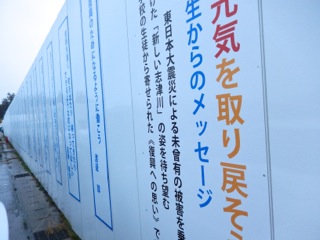
The first place we came to was a small festival. It was mainly with food, either to eat there or to take home. The soups were great, the seaweed and sea cucumber abundant. There was a wall with words of encouragement written by people who had visited the area.
A nearby community hall had a musician who sang, accompanied by mascots from all over Japan. They came out one after another to bow and dance to the eager audience. It was a sweet gesture to give people a sense of fun and of being cared about.

Our next stop was the Sun Sun Shopping Plaza. It was a temporary establishment with makeshift shops run by people who lost everything in the 03/11 disaster. That place will be in its present location for five years. Despite its vulnerability, that spot was selected because land was available. Minami San Rikucho is wedged on a very narrow strip of land between the sea and the mountains. There is very little space for building. No one wants to be near the sea now, so any land there is readily available. So now Sun Sun Shopping Plaza is very near the ocean, but the next site will be further inland and higher up. Now work is being done to build up the land so that structures will, hopefully, be less susceptible to the next monstrous surprises from the sea.

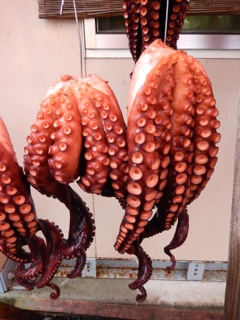
It was very touching seeing so many people coming to Sun Sun Plaza. The restaurants were full and the shops had lots of customers. Everyone wanted to support the locals, so they loaded up on gifts to take back home to family and friends. Again, the main fare was seaweed or fish. But there was also octopus since Minami San Rikucho’s mascot is a bright red manga version of that wonderful creature.

The other side of the parking lot from Sun Sun Plaza looked more serious, so while my friends got soft ice cream for their kids, I wandered over for a look. One building housed a photo show of before and after shots of March 11, 2011. The other was called Amway House. It was an attractive wooden building that had a very hopeful sign outside. Part of what it said was:
Remember: “The events of the day can never be forgotten.”
Hope: “Developing Hope” is one of the fundamentals of Amway.
These two ideas are embodied in Amway Japan social contribution activities with two key initiatives of building Community Houses and supporting community recovery projects in the region devastated by the Great East Japan Earthquake.


Amway’s effort is very beautiful and deeply appreciated, of course. But what for me was one of the most delightful surprises were “paper” cuts that have become a hallmark of Minami San Rikucho. They are not really paper at all, although they look like it. Rather they are delicate designs and messages cut out of wooden boards.

Because the disaster was so awful and because so many people suffered terribly from the tsunami, many kind folks wanted to help them. One such was a group called Envisi. Actually, they had been active in Miyagi since before the earthquake and had even done work in Minami San Rikucho. In their own words:
In 2010, we organized a project of making “Kiriko” (local tradition of paper cutting craft with white paper) in collaboration with people of Minamisanriku. It was a community art project in which, together with local women, we created works of art that represented “living” of people in local stores and seafood industry in the form of beautiful cut paper.
On March 11th, 2011, a devastating tsunami hit the town and everything was lost – things which had been handed down from generation to generation, sweet homes, loved ones…
Hand-in-hand with the people of Minamisanriku who are going through extreme hardships, we will keep on working for the town to help them keep “the sense of happiness of having lived in the town and of keep on living there”.
The magical thing that Envisi did was to install those “Kiriko” boards in the places where shops had once stood.


There is so much beauty going on, even when things feel daunting in their enormity. But for the Japanese, twenty, thirty, or more years of reconstruction are part of the reality of life. And we know that the efforts we make today will benefit those who are here tomorrow. Headway is slow, but determination is strong. Without that, how can we ever expect to survive?

Love,
Anne
Yomawari in the Park
- At July 27, 2016
- By anneblog
- In Annes Letters
- 0
Dear Family and Friends,
It is always good when I can find time to volunteer at Yomawari to help feed the homeless. This time Imai Sensei was busy, so could not make it. But his partner Aoki Sensei and his wife Junko were there, as always.
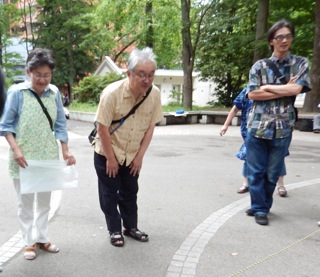
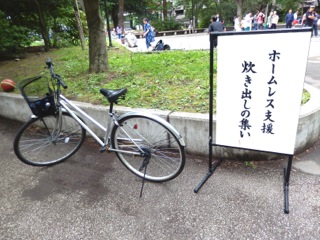
This time I went with three friends. Two of them live in Sendai, and one, a recent acquaintance named Austin, came up from Tokyo. He enjoys volunteering whenever he can. In fact, the first time I met him was in Fukushima’s infamous Minami Soma about nine months ago. He was helping to dig out places that were left behind because of the nuclear problems so close to the town.
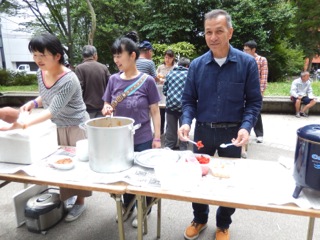
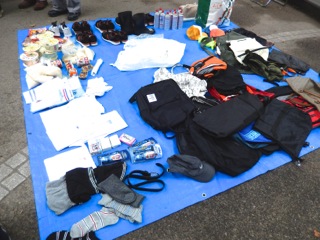
Today’s “Soup Run” followed its usual routine. The food had been prepared beforehand, so everyone, volunteers and homeless alike, helped unload the trucks and get things set up. There were the usual mats with tinned food and clothes for the men and women to select from, and of course, the tables with the hot lunch of rice and curry.

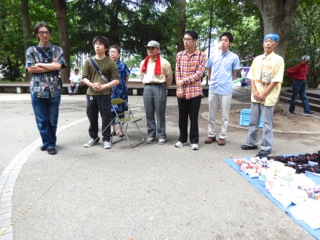
There is always a short meeting before we start and another when we finish. That allows everyone to have the same focus and to know how things will be run that day. Austin told me he was impressed by how orderly the people were and how respectfully they were treated. That is one of the hallmarks of Yomawari, I feel. It truly lives up to the Christian ideal of brotherly love.
Austin is American-Japanese, so knows both cultures and languages well. He is also very outgoing, so immediately went to talk with Aoki Sensei to learn more about what Yomawari Group does. When he finished, he said, “I am very impressed with what this group is doing.”
I asked Austin to elaborate, and he said, “Not only have they done a lot already to help these men get back on their feet, but they are planning some good things for the future, too. The one they are currently working on is farming. It seems Sendai City has some land that they are thinking of using for agriculture. Yomawari wants to be in on that. It has hopes of providing farm work on that property for the homeless. The produce they grow can be used for the “Soup Runs” and the rest can be sold. That way the men and women can earn some money, which will be beneficial for everyone.”
As I said good-bye to Austin, he shook my hand and said, “I am so glad I came here to volunteer. I hope to come back another time when they are making the food as well as serving it. I really want to contribute all I can to this wonderful organization.”
Love,
Anne
Kesennuma
- At July 27, 2016
- By anneblog
- In Annes Letters
- 0
Dear Family and Friends,
Kesen-numa is a small coastal city in the northern part of Miyagi Prefecture. During the horrific time of the 03/11 disasters, it was famous for two things. First was the enormous tanker that the relentless waves heaved several kilometers inland.

The other was fires that raged for days on end. Needless to say, the devastation was horrendous. And unfortunately, rebuilding has been slow. But gradually in some areas progress is being made.

Even though the controversial tanker has been removed, tragic landmarks from that blistering time still dot the cityscape. One middle school, for example, has been left pretty much as it was.


And semi-collapsed buildings have merely been covered with plastic sheets. They have not yet been dismantled or repaired.


(two years ago) (now)
Much of the port area is empty lots.

In fact, a group called “Mori wa Umi no Koibito”, or “A Forest is the Ocean’s Lover”, has been working for a long time from that perspective. That organization’s mission, like that of OISCA and the Iwanuma government further south, is to plant trees.

To quote a friend’s e-mail, “Mr. Hatakeyama, an oyster cultivator, is the man in the center who is really the personality who started planting trees in the mountains for a good environment in the ocean and eventually good harvest of the oysters. His word “http://www.mori-umi.org/” has spread and become very popular nation-wide. He started this movement and his hidden agenda was to stop the government’s plan to build a dam 8km away from the sea, which would have influenced the quality of the sea water and given damage to the ocean environment and to the oyster cultivation. Eventually, the dam was not built because the movement of protecting the ocean environment by planting trees became so popular. He is now fighting to stop the high dyke after the tsunami.”
Also on the bright side, the port area is now filled with working boats and a few fish-packing enterprises.


There is also a small, but colorful temporary shopping complex. It consisted of teeny enterprises, selling seaweed and fish, local products and souvenirs.


I asked her if it was hard to move forward after her heart had been forced opened and wounded so deeply. “I’m still very sad,” she said thoughtfully. “But I remember the words of my grandparents when I was little. They died in the tsunami, but I can still hear what they said very clearly. ‘We Japanese have been through so much. And we never give up. It is essential to live anchored in the past, fully in the present, and never forgetting the promise of tomorrow.’”

Love,
Anne
Another Day Planting Trees
- At July 27, 2016
- By anneblog
- In Annes Letters
- 0
Iwanuma is the township adjacent to Natori, where OISCA does its great work. Sendai Airport is in Iwanuma, so getting that area back on its feet quickly is crucial.
Both Natori and Iwanuma are working to create a safe coastal region. Yet, the two have very different approaches. Natori and OISCA have a plan to reforest the region with a uniform pine tree forest. They want to use mainly locals. Iwanuma’s program is more varied. Instead of only a single forest, its work includes a large park. It will eventually extend from the sea wall to several kilometers inland. This recreational area already has large expanses of open space, dotted here and there with low mounds. On top of those pimples of land are gazebos with artwork and memorial stones, plus views of the sea.

Unlike OISCA’s gracious NGO endeavor, this one was enormous. Iwanuma City government sponsored it. So, rather than 350 volunteers, there were about 6000! Naturally, the atmosphere between the two events was vastly different.

I went with a friend and her neighbors. As before we were greeted at the airport with people holding signs. Since the site was nearby, we walked. Naturally, there were hordes of us, so all along the route there were other people indicating the correct path.
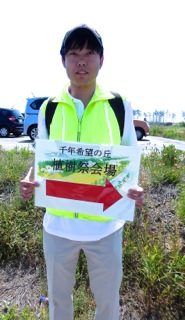
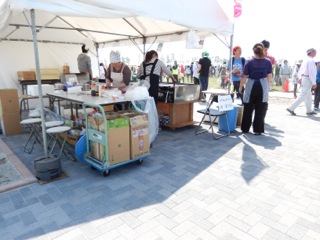
When we arrived at the registration area, it felt like a carnival. There was music blaring out of loud speakers, food stalls, and huge banners advertising which companies and groups were there.
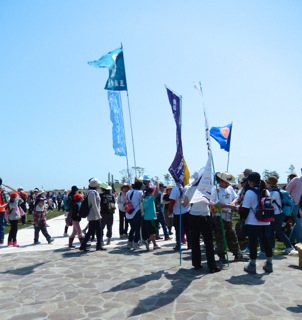


After all 6000 of us had finally assembled into our neat little groups, we were told to stand and face east. That is, towards the Mother of this entire project: the Ocean. We bowed our heads in silent prayer of humility before Forces larger than ourselves and of respect to those lost in the tsunami.
Then we all sat down and were introduced to important guests. The son of Koizumi was one of several politicians. Plus there were TV talents and radio hosts, university presidents and, happily, a cluster of local school children. And the press, of course.


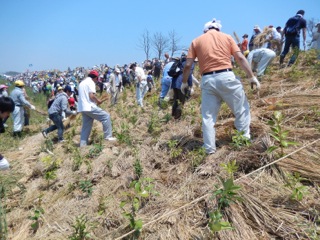
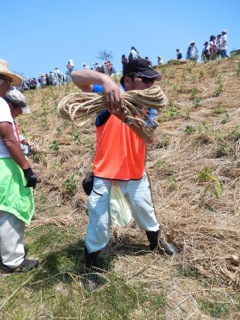
We were to plant a “natural” forest with sixteen varieties of trees.


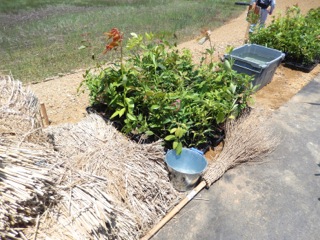

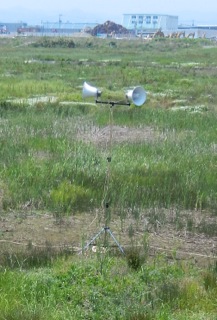
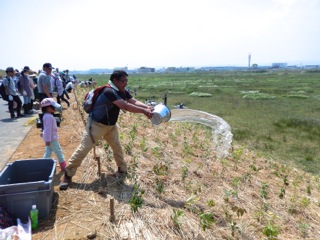
First we were given a demonstration on how to plant the trees. “We want a natural forest, so put things randomly, but not too close together.”


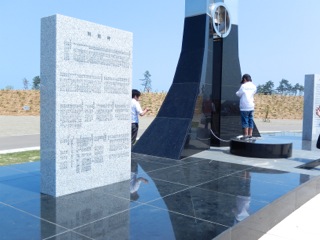
The bell itself was like an altar. Anyone could ring it. All who did then bowed and placed their hands in a gesture of prayer. There was a continuous line of people who sought that place of reflection and respect. The bell chimed non-stop the entire day.

I stayed for a long while in that sacred space. But eventually I headed back to the Disneyland arena, where a cowboy-clad singer was wailing away and crowds were munching on rice balls and sweet cakes.

Love,
Anne
OISCA — Tree Planting Day
- At July 27, 2016
- By anneblog
- In Annes Letters
- 0
Dear Family and Friends,
OISCA is Japan’s Johnny Appleseed. It is not an individual, and it does not stick to apple trees. But it serves the same purpose as Johnny: creating forests. OISCA is Japan’s oldest NPO. For fifty plus years it has devoted itself to reestablishing life via planting trees in places devastated by war or natural disasters.
When the infamous tsunami of 03/11 devoured the Northeast coast of Japan, OISCA immediately made itself available for assistance. Since then, both professionals and volunteers have worked tirelessly on a vast reforestation project in Miyagi. It will take ten years, but OISCA thinks long term and does very careful and precise planning. And sure enough, their vision of a coastal black pine forest is gradually taking shape.
Most of this project is done by local volunteers. After all, they are the ones who will live here long after OISCA’s work is completed.
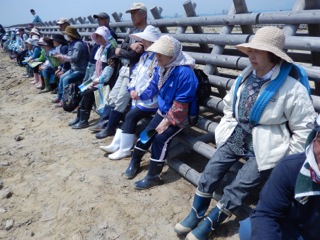

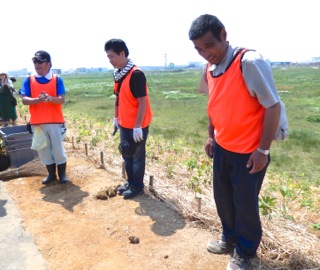
In addition, each of us short-term volunteers had received an instruction package in the mail. We were told what to bring, what to wear, how the day would be organized, and how to plant the small saplings.
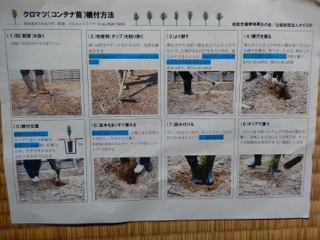
Likewise, before we arrived, OISCA staff had painted sticks with a blue tip and had placed each one where the trees were to be planted.

The work was to take place behind Sendai Airport. When we arrived there, men with very clear signs were waiting for us. They politely showed us where the buses were to transport us to the site.

There were 350 volunteers in all. Since most of us had no real experience, OISCA staff carefully demonstrated exactly what we should do.


Each pair was responsible for one long row. So we all followed our line of blue-tipped sticks that paralleled the coast. Dig, plant, stomp, spread. Dig, plant, stomp, spread.


After we finished, there were speeches of appreciation. The Vice President of OISCA said how deeply he loved the people of this area. He told a story about an incident that had deeply impressed him. After the earthquake banks were giving people a bit of cash, about $300. One day an old woman came to give back what she had received. “I gratefully took this money,” she explained. “But when I got home, my son had also gotten some. I felt that two people in one family getting money was not fair to others, so I’ve come to return what I was given.”
“Now how can you not love and deeply respect people like that?” the Vice President said. Then he continued, “I’m old now, so I won’t see this forest in its full glory. But many of you will. And pine trees are very sensitive. They carry the spirits of those who died here. And they will carry our spirits and intentions as they grow and stand strong for centuries.”
Just then, someone pointed to the sky and said, “Look!” It a very clear day, but overhead was an unusual rainbow. One part of it was a circle. Another formed two perfect wings.
Angels.

Indeed, the spirits of those before us were there. Surely they were hovering close, lifting the veil between us and them, and showering us with their blessings.
Kurikoma, Japan, May 2014
- At July 27, 2016
- By anneblog
- In Annes Letters
- 0
Dear Family and Friends,
Kurikoma is in Miyagi Prefecture, northwest of Sendai. It is not near the sea, but rather lies within the mountainous backbone of Japan.
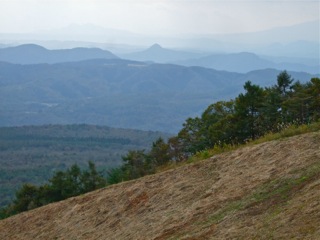
Despite those horrific events, the survivors immediately picked up their lives and focused on rebuilding. It has taken more than five years, but slowly the locals and government have cleared up the debris and are bringing life back to a sort of normalcy. In fact, the amount that has been accomplished is impressive.
Usually in rural Japan the variety of houses is a fascinating pleasure of discovery. But now with farmhouses and entire villages reconstructed, everything is new, and most often uniform. But even so, they still maintain the tidy dignity of Japanese farm life.
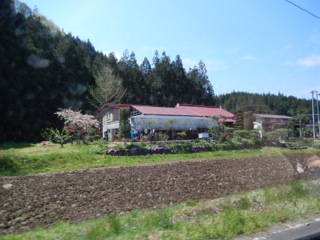
Being part of a collective culture, many Japanese feel a deep necessity to help their people in need. That support may not be as direct as the outpouring of the assistance that happened in 2011. But even so, individuals do all they can to help fellow citizens in trouble. One way that this is expressed is, surprisingly, through tourism. Now that many of the roads have been repaired and places are slowly beginning to reopen, people from far away are kindly choosing to go to the Tohoku area for their vacations.
Early spring can be very beautiful anywhere. And this year Kurikoma was blessed with soft new greens inter-dispersed with a shimmer of flowering trees.


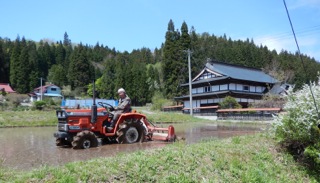
Also, that weekend was the time of rice planting. So many farmers were out turning and flooding their fields, while others had already started planting their vivid green sprouts.

Love,
Anne
Planting Hope #2 — OISCA
- At July 27, 2016
- By anneblog
- In Annes Letters
- 0
A few months ago I wrote about a tree-planting project going on just outside of Sendai, in a town called Natori. An NGO called OISCA is deeply involved in that life-enhancing work.
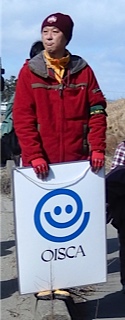
Part of their job entails gaining support of locals, so they do all they can to include them in planning and activities. For example, they subcontract local tsunami survivors, many of whom are farmers. Those folks have helped start the seedlings, are nursing them carefully, and will be part of the team to plant the baby trees in the spring.
Recently, too, OISCA has held town meetings to explain their project to the people in the area. Also the other day they ran a morning tour of places where they had been working. Since I am keenly interested in what is happening in this region, I signed up to join them.
This tour was for educational purposes, so there was Professor Ota Takehiko, Professor Emeritus of Tokyo University, plus several other experts on pine trees and forests. The Mayor of Natori City also joined us. These gentlemen shared many interesting points about black pine trees and why there were the best choice for this area.

As the bus rolled out to the coastal areas, we looked at charts and listened to explanations about the intricacy of this vast, far-reaching endeavor. We learned that black pine trees have an extremely sturdy root system. They are very hardy trees, but also sensitive to the earth they are in. So if the land is low, the roots tend to spread horizontally. But even with a slight rise, they will grow vertically and deeply, which makes for a more stable outcome.

And sure enough, as we went through the low, almost treeless, tsunami-hit areas, we passed a teeny pimple of risen land. A small shrine had been built there, and lo and behold, pine trees were tenaciously clinging to the soil around it. They had survived the tremendous force of the tsunami, although all the trees just next to them on lower ground had perished.

I have wandered many times in the area where OISCA is working. However, I had never realized that wonderful organization was part of the rebuilding going on in that specific place. I had mostly seen trucks plying back and forth, moving salt-filled earth and replacing it with fresh soil. I know about the park to be built behind the sea wall. And I had listened to the tales of farmers losing their land because of all these changes. But this time I was able to learn about the master plan for this devastated area.
The sea wall is there, in concrete. But behind that there is a man-made rise of land with triangular wooden frames. I had photographed those structures on previous occasions, but this time I learned their specific purpose. They are there to protect the young black pine forest that OISCA is helping to birth.

Wind is a huge factor in this stretch of land between the mountains and the sea. Yet, strangely, the protective wooden frames are not solid. Rather, they have many slats. Those breaks in the sides of the frames are for the wind to go through, while still protecting the precious new life of the saplings. If the frames were solid, the wind would swoop up violently and then pound down hard on the earth, causing great damage to both the soil and the plants. But with the space, the air goes through evenly, and skims across the land relatively smoothly. In that way, the trees are better able to withstand the fierce gales that are notorious in this region.

There are three rows of financial responsibility for this immense project. The strip of land closest to the ocean is Miyagi Prefecture’s domain. The next is Natori City’s concern. The final one is the Japanese government’s area. OISCA is involved in all three of them, providing the expertise, management, and direction needed for this ten-year project to materialize. Beyond the forest park will be a buffer zone then farms and a road. Three kilometers and further inshore will be the homes of locals.
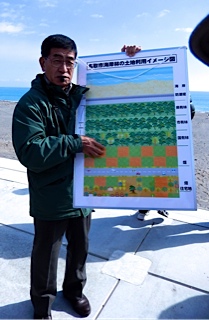
At the end of the tour we went to see the seedlings and baby pine trees that have been stretching and growing over the winter. The planning of this project is very precise. At first ten grams of seeds are planted in one-meter square areas. As they grow, they are thinned out. When the actual planting of the forest takes place, the trees will be placed 1.4 meters apart. OISCA is talking about 50,000 trees, so you can imagine the work involved and the enormous area to be covered.

The best time to transplant is when the infant trees are from 25–35 centimeters high. In order to prevent them from growing beyond that height, these babies are deliberately not fertilized. If they were given extra nutrients, they would grow too quickly and too large. That would cause problems later when it came time to shift them to their permanent locations.
When OISCA first began working here, they planted seedlings directly into the soil. There were nets to protect the baby shoots from the wind. However, later the government passed a law that seedlings had to be planted in small plastic containers in greenhouses. The work is easier that way, but unfortunately it is also more expensive. That frustrates the situation, but rules are rules, so OISCA complies.

Before arriving at OISCA’s “seeding farm”, we went quite far down the beach, further than I had ever walked. There amid the high grasses was a stone monument. It had been placed there many years before. Miraculously, it had withstood the tsunami with only a broken top.

Ironically, it was there to commemorate a tree-planting project that had been executed long, long ago by locals. They were not professionals – maybe students, office workers, housewives, and farmers. But the trees had lasted for years, even though they were all gone now.
OISCA’s project is similar, but more professional, with technological expertise and precision. But the heart is the same: the desire to make Miyagi a viable area for farming, fishing, and living – with trees as the backbone and nurturing mother for centuries to come.

Love,
Soup Run and Abuse
- At July 27, 2016
- By anneblog
- In Annes Letters
- 0
March 2014
Dear Family and Friends,
As most of you know, all sales from my book, Letters from the Ground to the Heart, go to Imai Sensei’s NGO for the homeless, Yomawari. Unfortunately, book sales have been dire lately, so there have not been any funds to offer Imai Sensei’s ongoing, much-needed endeavor. However, the BIEM (Block Island Ecumenical Ministries), which is responsible for getting any book income to Sendai, very open-heartedly contacted the Roosa Fund about a grant. That wonderful organization most generously allowed us a tidy sum, over half of which, $3500, went right to Yomawari.
Recently I had time to volunteer at the Soup Run. At that time, I asked Imai Sensei if any money had come from America. His face lit up and he said, “Yes! Yes! We were so excited. Things like that don’t happen, especially out of the blue. So it was like manna from heaven. Thank you. Thank you. Thank you!” he said over and over again. He had posted a letter of gratitude on the Yomawari blog, but had not been completely sure where the money had come from to thank them directly.

Because of the extra cash, today’s meal was particularly rich and nourishing. There were plenty of fresh vegetables, pork, and even baby sausages.


The miso for soup seemed more delicious than ever. And there was enough rice for everyone to come back for seconds and even thirds.


As usual I was impressed by how well everything was organized. Volunteers arrived on time and immediately plunged into the work of washing, chopping, and slicing. Everyone knew exactly what to so and did it with a blend of casual focus and merry laughter.


There were familiar faces and new, each eager to help in his or her own particular way.

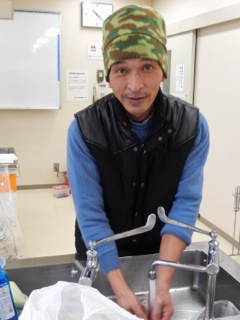
After the food was prepared, we volunteers ate a small lunch before heading upstairs for a meeting with the homeless participants. The men were told what services were to be offer for them this month. Of course, they could ask questions. Then we served the meal.


Yomawari was actually founded by three gentlemen: Imai Sensei, Aoki Sensei, and Shiyomi San. All three share responsibilities, but Imai Sensei is the most public, going for interviews and conferences, doing close work with government officials, and constantly pushing to collect funds, get food, and run programs such as showers and laundry service. Aoki Sensei is his right hand man and is with him always.

Shiyomi San runs the counseling branch of Yomawari. He helps with jobs, housing, and medical care. Each of these men is truly an angel in human form, as are the volunteers who offer their selfless service week after week.

Imai Sensei told me about a recent scandal concerning the homeless. Several companies had been recruiting these vulnerable gentlemen to clean up the Fukushima Nuclear Plant. Their job included a daily wage, dormitory space, and meals. The terms seemed good, so many men headed to Fukushima and gave their all, despite the dangers of the job.
It seems foreign journalist came to have a look at what was evolving at Fukushima. While there, they learned that the homeless men were being very badly exploited. The company bosses, Yakusa connected, had taken half the promised wages for themselves. In addition, they had charged for room and board. So at the end of the month, the hardworking homeless men had received no pay.
Reports of this abuse appeared in European newspapers. That, of course, caused an uproar. But here in Japan nothing at all appeared in the news. However, once the scandal was exposed, Imai Sensei was interviewed about it. He pointed out that many men had left Sendai with the promise of legitimate work. But since they had been cheated, they were now flocking back. That means Yomawari’s responsibilities have increased ten-fold as it tries to assist the influx of disillusioned men.


And the recipients were indeed grateful. Every one of them came to us after eating, and bowed very low. “Thank you,” they said. “Thank you for today’s warm meal. Thank you for your ongoing, loving care for us. Without you, where would we be?”
Love,
Anne
Watching the Progress
- At July 27, 2016
- By anneblog
- In Annes Letters
- 0
Dear Family and Friends,
In my most recent message to you, I talked about the organized Japanese mind. I mentioned long-term programs that were in place, in anticipation of the next natural disaster that would devastate one region or another of this beautiful archipelago.
By coincidence a few days after my letter to you, there was an article in the newspaper about a website the Tohoku University had posted. One department of that school is called IRIDeS, or the International Research Institute of Disaster Science. It has been tracking changes in this area since the life-altering events of March 11, 2011. And that is what this website is about.
http://michinoku.irides.tohoku.ac.jp/photovr/map.html

The next step is to click on the teeny picture. When you do that, a larger version of the same image appears on the right of the screen. Above that photo there is an arrow and a line. If you move the arrow from left to right, you will be able to see a progression of changes that have occurred since the initial damage. Some show only two: then and very recently. But others give a more detailed record of change, in some incidents as many as six or seven. What adds to the fascination is that the images do not jump from one to another, but rather evolve. That gives a sense of gradual change over time.

Of course, some areas were so devastated that there are many balloons piled on top of one other. In that case, it is impossible to click on any one of them. But not to worry. If you look to the left of the screen, you will see a small man. Below him is an indicator, which you can slide up or down to alter the size of the map. By increasing the size, the balloons separate, making it easier to click on each one.

Anne
UN Conference on Natural Disasters
- At July 27, 2016
- By anneblog
- In Annes Letters
- 0
January 2014
Dear Family and Friends,
There are many things I deeply admire about the Japanese. One of them is their long-term view of things. Coupled with that is their attitude that any goal can be achieved only by taking one small step at a time.
A perfect example of that, of course, is the recovery work here in Tohoku after the March 11, 2011 earthquake and tsunami. Literally hundreds of thousands of people have – and still are – contributing their efforts to get this area back on its feet. No one expects results overnight. Rather, they are thinking in terms of several generations; that is, thirty or forty years, or even longer.
A significant part of the recovery process includes more than Japan. This is reflected in the United Nation’s International Conference on Disaster Risk Reduction, to be held in Sendai in March 2015.

and his colleagues are taking careful measures to insure the event will be as inclusive as possible. Part of that is to make it be a community offering, not just a government responsibility. One aspect of that is to include students from local universities in the preparations and conference itself. So despite his heavy schedule as a government official, Hidetaka Yanatsu takes time to visit schools and to carefully explain his vision for the conference and students’ roles in it.
Miyagi University of Education (MUE) in Sendai is one place Hidetaka Yanatsu has targeted for assistance. After the March 11 tragedy, as an educational institution, MUE felt a tremendous responsibility to be of service, especially for children.

So the administration established a volunteer program. Even now, almost three years later, that group is still strong. Participants go to temporary housing complexes to give classes or hold special events. Now they are discussing ways of expanding their work to include help for survivors of Typhoon Haiyan in the Philippines.

MUE’s volunteers recently sponsored a week-long series of lectures aimed at discussing ongoing disaster issues. Hidetaka Yanatsu gave the opening speech. Of course, he talked about the UN conference next year. But his talk was much larger than that.

He also discussed many dimensions of emergency preparedness. He stressed that one of the most important ways to prepare is by networking and communication, not only in times of emergency, but also in daily life. Good communication builds up confidence and trust between people, so they can work better together in times of need. Of course, the Internet is invaluable for that. But Hidetaka Yanatsu went further. He explained how in the Tohoku area, which is basically rural, the strength of the community was one of the best sources of communication and of personal protection.


Hidetaka Yanatsu also added the dimension of role models. “We need leaders that we can look up to, of course,” he said. “Those should be not only government officials, but also ordinary people.” He suggested that this sense of leadership and unity among citizens should include individuals and local organizations, of course, and also universities, NPOs, and the army, to name a few.
He went on to say how a wide variety of media could also be very useful. And this should be done long before a catastrophe happened. He suggested art shows, classes in schools, and town meetings.


Students going to higher ground, as part of a tsunami drill
The point was to build up communication and trust so that when an emergency struck, people could immediately step into action. And in Japan the question is never “if”, but rather “when” there will be another major catastrophe.
Because of Japan’s ongoing natural disasters, relief measures have been in place for years. Relatively recently, the very damaging Hanshin Earthquake took place in Kobe in 2005. Kobe is located in the Hyogo area of Japan. So that major catastrophe lead to a ten-year relief program, called the Hyogo Framework of Action (HFA). Since the HFA program was firmly in place on March 11, 2011, the government was able to immediately implement relief efforts in Tohoku.

In other words, planning far in advance and working step-by-step are extremely helpful measures, especially in times of emergency.
Hidetaka Yanatsu concluded his informative speech by saying that although the Great East Japan Earthquake and Tsunami was far more devastating than anyone ever anticipated, and although it will take many, many years to reconstruct this area, we cannot stop making efforts. “We have to think long-term. We have to think even beyond Tohoku’s recovery. We have to ponder the long-term influence of the work being done now. And we must take small steps to achieve our goals. For example, we have to consider how the UN Conference on Disaster Risk Reduction will help other nations. We even should even think about how the Tokyo Olympics in 2020 will affect our future. We must think far ahead and plan accordingly.
“And it is crucial to look forward positively. That way we can create in our minds and in our daily lives the kind of future we want for our families, ourselves, our country, and the world.”

Anne


