
Fragility and Resistance
- At July 27, 2016
- By anneblog
- In Annes Letters
 0
0
Dear Family and Friends,
Recently one of my students told me about her friend who came from Fukushima. She told me her friend’s brother had developed a cyst on his thyroid gland. He was age 9 when the abnormality was found. He is now 12 and it is still there. She reassured me it was not malignant – yet – but they were keeping a close watch on it. I had not heard about this development before. I was concerned, of course, but not really surprised that it had not been reported.


As in other parts of the world, young people in general are disillusioned and lost. With the terrible economy, this generation has little sense of a future. “They have no dream,” as many people say. “And how can you live without a dream?”
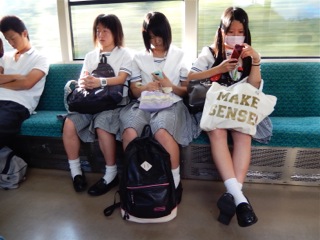
A few steps are appearing that begin to address this challenging necessity. One example is that over the past months Family Support Centers have started to boldly present their services. In the past, having emotional trouble was taboo and something to hide. But now it is openly recognized, so people are able to find help more easily and without shame. Likewise, there are seminars on Loneliness and Post Traumatic Stress. And university programs in counseling are now being advertised in public places, such as on buses or trains.


trampolines, elastic waistbands,
yoga masters, Scrunchies.
Visualize the rebound of young skin
touched, the springiness of muffins
fresh from the oven.
Listen to tragedies’ survivors say,
“Yes, I lost everything. Everything.
But I still have my life.”
Ever-vulnerable human beings
somehow bounce back,
some times even thrive.
“Resilient,”
bravehearts,
my word for you.
Love,
Anne
Hope for Minami San Rikucho
- At July 27, 2016
- By anneblog
- In Annes Letters
- 0
Dear Family and Friends,
Recently I wrote about Minami San Rikucho and its “Angel Voices”. Those generous souls are now an integral part of that community’s deepest psyche. The trip that taught me about those selfless members of the community was sponsored by the Miyagi University of Education. So it was basically a study tour. We learned a lot about the tsunami and the ongoing problems the town is having as it struggles to find and rebuild itself.
The second time I went this summer was on a personal trip with friends. So the places we visited were very different. And of course, the impression of the town was not at all the same either. First of all, we had four kids under age ten with us, so the emphasis was on entertaining the youngsters as well as seeing what we could.
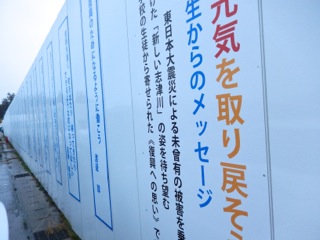
The first place we came to was a small festival. It was mainly with food, either to eat there or to take home. The soups were great, the seaweed and sea cucumber abundant. There was a wall with words of encouragement written by people who had visited the area.
A nearby community hall had a musician who sang, accompanied by mascots from all over Japan. They came out one after another to bow and dance to the eager audience. It was a sweet gesture to give people a sense of fun and of being cared about.

Our next stop was the Sun Sun Shopping Plaza. It was a temporary establishment with makeshift shops run by people who lost everything in the 03/11 disaster. That place will be in its present location for five years. Despite its vulnerability, that spot was selected because land was available. Minami San Rikucho is wedged on a very narrow strip of land between the sea and the mountains. There is very little space for building. No one wants to be near the sea now, so any land there is readily available. So now Sun Sun Shopping Plaza is very near the ocean, but the next site will be further inland and higher up. Now work is being done to build up the land so that structures will, hopefully, be less susceptible to the next monstrous surprises from the sea.

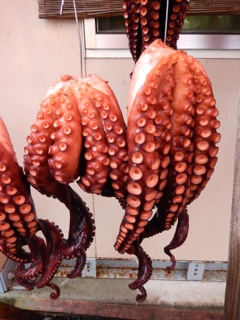
It was very touching seeing so many people coming to Sun Sun Plaza. The restaurants were full and the shops had lots of customers. Everyone wanted to support the locals, so they loaded up on gifts to take back home to family and friends. Again, the main fare was seaweed or fish. But there was also octopus since Minami San Rikucho’s mascot is a bright red manga version of that wonderful creature.

The other side of the parking lot from Sun Sun Plaza looked more serious, so while my friends got soft ice cream for their kids, I wandered over for a look. One building housed a photo show of before and after shots of March 11, 2011. The other was called Amway House. It was an attractive wooden building that had a very hopeful sign outside. Part of what it said was:
Remember: “The events of the day can never be forgotten.”
Hope: “Developing Hope” is one of the fundamentals of Amway.
These two ideas are embodied in Amway Japan social contribution activities with two key initiatives of building Community Houses and supporting community recovery projects in the region devastated by the Great East Japan Earthquake.


Amway’s effort is very beautiful and deeply appreciated, of course. But what for me was one of the most delightful surprises were “paper” cuts that have become a hallmark of Minami San Rikucho. They are not really paper at all, although they look like it. Rather they are delicate designs and messages cut out of wooden boards.

Because the disaster was so awful and because so many people suffered terribly from the tsunami, many kind folks wanted to help them. One such was a group called Envisi. Actually, they had been active in Miyagi since before the earthquake and had even done work in Minami San Rikucho. In their own words:
In 2010, we organized a project of making “Kiriko” (local tradition of paper cutting craft with white paper) in collaboration with people of Minamisanriku. It was a community art project in which, together with local women, we created works of art that represented “living” of people in local stores and seafood industry in the form of beautiful cut paper.
On March 11th, 2011, a devastating tsunami hit the town and everything was lost – things which had been handed down from generation to generation, sweet homes, loved ones…
Hand-in-hand with the people of Minamisanriku who are going through extreme hardships, we will keep on working for the town to help them keep “the sense of happiness of having lived in the town and of keep on living there”.
The magical thing that Envisi did was to install those “Kiriko” boards in the places where shops had once stood.


There is so much beauty going on, even when things feel daunting in their enormity. But for the Japanese, twenty, thirty, or more years of reconstruction are part of the reality of life. And we know that the efforts we make today will benefit those who are here tomorrow. Headway is slow, but determination is strong. Without that, how can we ever expect to survive?

Love,
Anne
Yomawari in the Park
- At July 27, 2016
- By anneblog
- In Annes Letters
- 0
Dear Family and Friends,
It is always good when I can find time to volunteer at Yomawari to help feed the homeless. This time Imai Sensei was busy, so could not make it. But his partner Aoki Sensei and his wife Junko were there, as always.
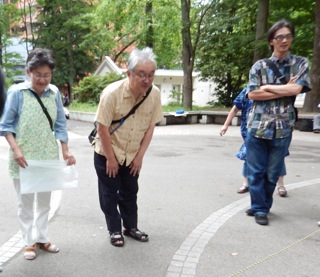
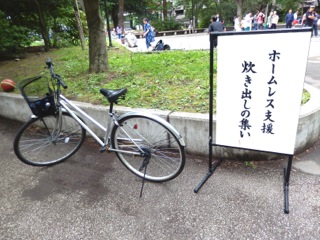
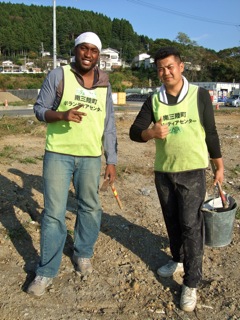
This time I went with three friends. Two of them live in Sendai, and one, a recent acquaintance named Austin, came up from Tokyo. He enjoys volunteering whenever he can. In fact, the first time I met him was in Fukushima’s infamous Minami Soma about nine months ago. He was helping to dig out places that were left behind because of the nuclear problems so close to the town.
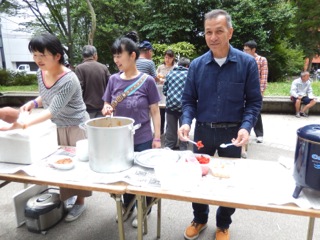
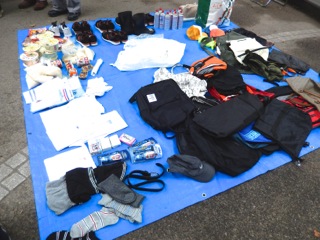
Today’s “Soup Run” followed its usual routine. The food had been prepared beforehand, so everyone, volunteers and homeless alike, helped unload the trucks and get things set up. There were the usual mats with tinned food and clothes for the men and women to select from, and of course, the tables with the hot lunch of rice and curry.

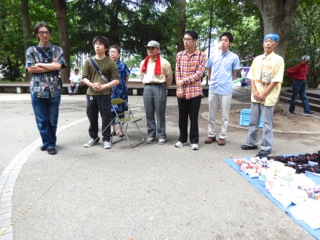
There is always a short meeting before we start and another when we finish. That allows everyone to have the same focus and to know how things will be run that day. Austin told me he was impressed by how orderly the people were and how respectfully they were treated. That is one of the hallmarks of Yomawari, I feel. It truly lives up to the Christian ideal of brotherly love.
Austin is American-Japanese, so knows both cultures and languages well. He is also very outgoing, so immediately went to talk with Aoki Sensei to learn more about what Yomawari Group does. When he finished, he said, “I am very impressed with what this group is doing.”
I asked Austin to elaborate, and he said, “Not only have they done a lot already to help these men get back on their feet, but they are planning some good things for the future, too. The one they are currently working on is farming. It seems Sendai City has some land that they are thinking of using for agriculture. Yomawari wants to be in on that. It has hopes of providing farm work on that property for the homeless. The produce they grow can be used for the “Soup Runs” and the rest can be sold. That way the men and women can earn some money, which will be beneficial for everyone.”
As I said good-bye to Austin, he shook my hand and said, “I am so glad I came here to volunteer. I hope to come back another time when they are making the food as well as serving it. I really want to contribute all I can to this wonderful organization.”
Love,
Anne
Kesennuma
- At July 27, 2016
- By anneblog
- In Annes Letters
- 0
Dear Family and Friends,
Kesen-numa is a small coastal city in the northern part of Miyagi Prefecture. During the horrific time of the 03/11 disasters, it was famous for two things. First was the enormous tanker that the relentless waves heaved several kilometers inland.

The other was fires that raged for days on end. Needless to say, the devastation was horrendous. And unfortunately, rebuilding has been slow. But gradually in some areas progress is being made.

Even though the controversial tanker has been removed, tragic landmarks from that blistering time still dot the cityscape. One middle school, for example, has been left pretty much as it was.


And semi-collapsed buildings have merely been covered with plastic sheets. They have not yet been dismantled or repaired.


(two years ago) (now)
Much of the port area is empty lots.

In fact, a group called “Mori wa Umi no Koibito”, or “A Forest is the Ocean’s Lover”, has been working for a long time from that perspective. That organization’s mission, like that of OISCA and the Iwanuma government further south, is to plant trees.

To quote a friend’s e-mail, “Mr. Hatakeyama, an oyster cultivator, is the man in the center who is really the personality who started planting trees in the mountains for a good environment in the ocean and eventually good harvest of the oysters. His word “http://www.mori-umi.org/” has spread and become very popular nation-wide. He started this movement and his hidden agenda was to stop the government’s plan to build a dam 8km away from the sea, which would have influenced the quality of the sea water and given damage to the ocean environment and to the oyster cultivation. Eventually, the dam was not built because the movement of protecting the ocean environment by planting trees became so popular. He is now fighting to stop the high dyke after the tsunami.”
Also on the bright side, the port area is now filled with working boats and a few fish-packing enterprises.


There is also a small, but colorful temporary shopping complex. It consisted of teeny enterprises, selling seaweed and fish, local products and souvenirs.


I asked her if it was hard to move forward after her heart had been forced opened and wounded so deeply. “I’m still very sad,” she said thoughtfully. “But I remember the words of my grandparents when I was little. They died in the tsunami, but I can still hear what they said very clearly. ‘We Japanese have been through so much. And we never give up. It is essential to live anchored in the past, fully in the present, and never forgetting the promise of tomorrow.’”

Love,
Anne
Another Day Planting Trees
- At July 27, 2016
- By anneblog
- In Annes Letters
- 0
Iwanuma is the township adjacent to Natori, where OISCA does its great work. Sendai Airport is in Iwanuma, so getting that area back on its feet quickly is crucial.
Both Natori and Iwanuma are working to create a safe coastal region. Yet, the two have very different approaches. Natori and OISCA have a plan to reforest the region with a uniform pine tree forest. They want to use mainly locals. Iwanuma’s program is more varied. Instead of only a single forest, its work includes a large park. It will eventually extend from the sea wall to several kilometers inland. This recreational area already has large expanses of open space, dotted here and there with low mounds. On top of those pimples of land are gazebos with artwork and memorial stones, plus views of the sea.

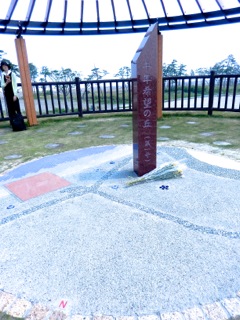
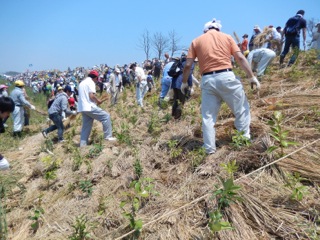
Unlike OISCA’s gracious NGO endeavor, this one was enormous. Iwanuma City government sponsored it. So, rather than 350 volunteers, there were about 6000! Naturally, the atmosphere between the two events was vastly different.

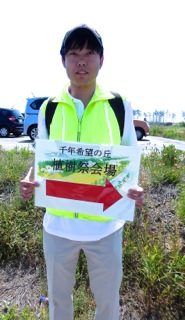
I went with a friend and her neighbors. As before we were greeted at the airport with people holding signs. Since the site was nearby, we walked. Naturally, there were hordes of us, so all along the route there were other people indicating the correct path.
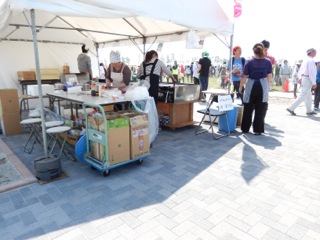
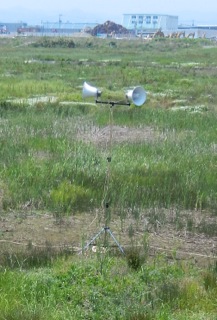
When we arrived at the registration area, it felt like a carnival. There was music blaring out of loud speakers, food stalls, and huge banners advertising which companies and groups were there.
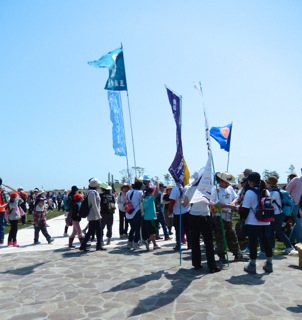


After all 6000 of us had finally assembled into our neat little groups, we were told to stand and face east. That is, towards the Mother of this entire project: the Ocean. We bowed our heads in silent prayer of humility before Forces larger than ourselves and of respect to those lost in the tsunami.
Then we all sat down and were introduced to important guests. The son of Koizumi was one of several politicians. Plus there were TV talents and radio hosts, university presidents and, happily, a cluster of local school children. And the press, of course.


We were to plant a “natural” forest with sixteen varieties of trees.

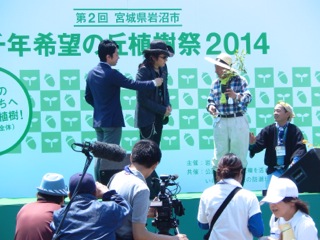
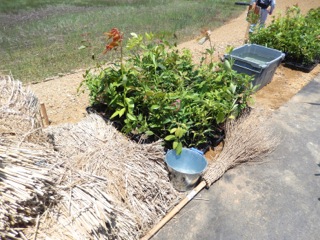

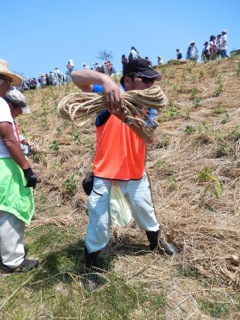
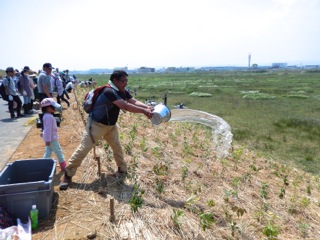
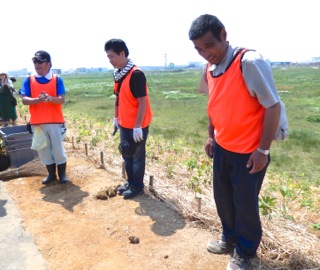
First we were given a demonstration on how to plant the trees. “We want a natural forest, so put things randomly, but not too close together.”


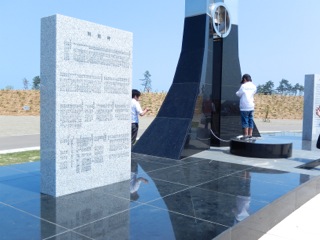
The bell itself was like an altar. Anyone could ring it. All who did then bowed and placed their hands in a gesture of prayer. There was a continuous line of people who sought that place of reflection and respect. The bell chimed non-stop the entire day.

I stayed for a long while in that sacred space. But eventually I headed back to the Disneyland arena, where a cowboy-clad singer was wailing away and crowds were munching on rice balls and sweet cakes.

Love,
Anne
OISCA — Tree Planting Day
- At July 27, 2016
- By anneblog
- In Annes Letters
- 0
Dear Family and Friends,
OISCA is Japan’s Johnny Appleseed. It is not an individual, and it does not stick to apple trees. But it serves the same purpose as Johnny: creating forests. OISCA is Japan’s oldest NPO. For fifty plus years it has devoted itself to reestablishing life via planting trees in places devastated by war or natural disasters.
When the infamous tsunami of 03/11 devoured the Northeast coast of Japan, OISCA immediately made itself available for assistance. Since then, both professionals and volunteers have worked tirelessly on a vast reforestation project in Miyagi. It will take ten years, but OISCA thinks long term and does very careful and precise planning. And sure enough, their vision of a coastal black pine forest is gradually taking shape.
Most of this project is done by local volunteers. After all, they are the ones who will live here long after OISCA’s work is completed.
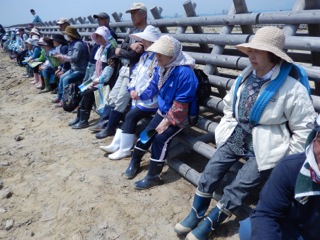

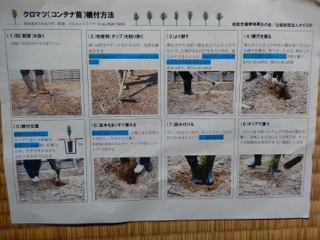
In addition, each of us short-term volunteers had received an instruction package in the mail. We were told what to bring, what to wear, how the day would be organized, and how to plant the small saplings.
Likewise, before we arrived, OISCA staff had painted sticks with a blue tip and had placed each one where the trees were to be planted.

The work was to take place behind Sendai Airport. When we arrived there, men with very clear signs were waiting for us. They politely showed us where the buses were to transport us to the site.

There were 350 volunteers in all. Since most of us had no real experience, OISCA staff carefully demonstrated exactly what we should do.


Each pair was responsible for one long row. So we all followed our line of blue-tipped sticks that paralleled the coast. Dig, plant, stomp, spread. Dig, plant, stomp, spread.


After we finished, there were speeches of appreciation. The Vice President of OISCA said how deeply he loved the people of this area. He told a story about an incident that had deeply impressed him. After the earthquake banks were giving people a bit of cash, about $300. One day an old woman came to give back what she had received. “I gratefully took this money,” she explained. “But when I got home, my son had also gotten some. I felt that two people in one family getting money was not fair to others, so I’ve come to return what I was given.”
“Now how can you not love and deeply respect people like that?” the Vice President said. Then he continued, “I’m old now, so I won’t see this forest in its full glory. But many of you will. And pine trees are very sensitive. They carry the spirits of those who died here. And they will carry our spirits and intentions as they grow and stand strong for centuries.”
Just then, someone pointed to the sky and said, “Look!” It a very clear day, but overhead was an unusual rainbow. One part of it was a circle. Another formed two perfect wings.
Angels.

Indeed, the spirits of those before us were there. Surely they were hovering close, lifting the veil between us and them, and showering us with their blessings.
Kurikoma, Japan, May 2014
- At July 27, 2016
- By anneblog
- In Annes Letters
- 0
Dear Family and Friends,
Kurikoma is in Miyagi Prefecture, northwest of Sendai. It is not near the sea, but rather lies within the mountainous backbone of Japan.
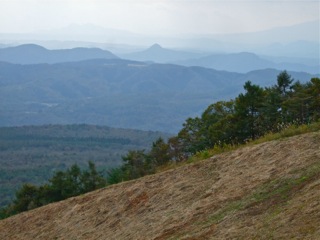
Despite those horrific events, the survivors immediately picked up their lives and focused on rebuilding. It has taken more than five years, but slowly the locals and government have cleared up the debris and are bringing life back to a sort of normalcy. In fact, the amount that has been accomplished is impressive.
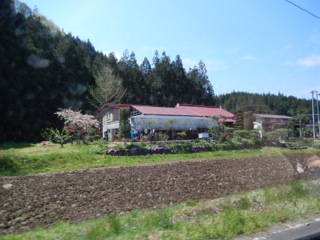
Usually in rural Japan the variety of houses is a fascinating pleasure of discovery. But now with farmhouses and entire villages reconstructed, everything is new, and most often uniform. But even so, they still maintain the tidy dignity of Japanese farm life.
Being part of a collective culture, many Japanese feel a deep necessity to help their people in need. That support may not be as direct as the outpouring of the assistance that happened in 2011. But even so, individuals do all they can to help fellow citizens in trouble. One way that this is expressed is, surprisingly, through tourism. Now that many of the roads have been repaired and places are slowly beginning to reopen, people from far away are kindly choosing to go to the Tohoku area for their vacations.
Early spring can be very beautiful anywhere. And this year Kurikoma was blessed with soft new greens inter-dispersed with a shimmer of flowering trees.


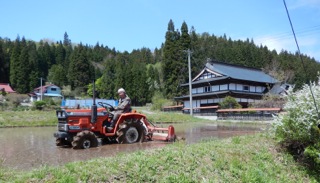
Also, that weekend was the time of rice planting. So many farmers were out turning and flooding their fields, while others had already started planting their vivid green sprouts.

Love,
Anne
Planting Hope #2 — OISCA
- At July 27, 2016
- By anneblog
- In Annes Letters
- 0
A few months ago I wrote about a tree-planting project going on just outside of Sendai, in a town called Natori. An NGO called OISCA is deeply involved in that life-enhancing work.
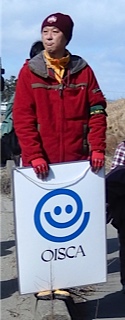
Part of their job entails gaining support of locals, so they do all they can to include them in planning and activities. For example, they subcontract local tsunami survivors, many of whom are farmers. Those folks have helped start the seedlings, are nursing them carefully, and will be part of the team to plant the baby trees in the spring.
Recently, too, OISCA has held town meetings to explain their project to the people in the area. Also the other day they ran a morning tour of places where they had been working. Since I am keenly interested in what is happening in this region, I signed up to join them.
This tour was for educational purposes, so there was Professor Ota Takehiko, Professor Emeritus of Tokyo University, plus several other experts on pine trees and forests. The Mayor of Natori City also joined us. These gentlemen shared many interesting points about black pine trees and why there were the best choice for this area.

As the bus rolled out to the coastal areas, we looked at charts and listened to explanations about the intricacy of this vast, far-reaching endeavor. We learned that black pine trees have an extremely sturdy root system. They are very hardy trees, but also sensitive to the earth they are in. So if the land is low, the roots tend to spread horizontally. But even with a slight rise, they will grow vertically and deeply, which makes for a more stable outcome.

And sure enough, as we went through the low, almost treeless, tsunami-hit areas, we passed a teeny pimple of risen land. A small shrine had been built there, and lo and behold, pine trees were tenaciously clinging to the soil around it. They had survived the tremendous force of the tsunami, although all the trees just next to them on lower ground had perished.

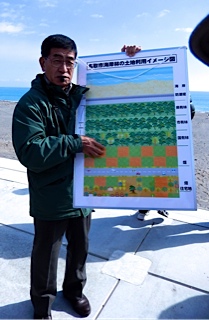
I have wandered many times in the area where OISCA is working. However, I had never realized that wonderful organization was part of the rebuilding going on in that specific place. I had mostly seen trucks plying back and forth, moving salt-filled earth and replacing it with fresh soil. I know about the park to be built behind the sea wall. And I had listened to the tales of farmers losing their land because of all these changes. But this time I was able to learn about the master plan for this devastated area.
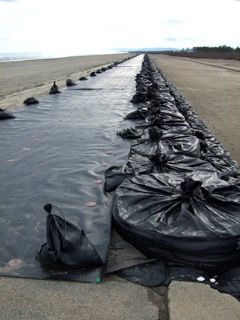
The sea wall is there, in concrete. But behind that there is a man-made rise of land with triangular wooden frames. I had photographed those structures on previous occasions, but this time I learned their specific purpose. They are there to protect the young black pine forest that OISCA is helping to birth.

Wind is a huge factor in this stretch of land between the mountains and the sea. Yet, strangely, the protective wooden frames are not solid. Rather, they have many slats. Those breaks in the sides of the frames are for the wind to go through, while still protecting the precious new life of the saplings. If the frames were solid, the wind would swoop up violently and then pound down hard on the earth, causing great damage to both the soil and the plants. But with the space, the air goes through evenly, and skims across the land relatively smoothly. In that way, the trees are better able to withstand the fierce gales that are notorious in this region.

There are three rows of financial responsibility for this immense project. The strip of land closest to the ocean is Miyagi Prefecture’s domain. The next is Natori City’s concern. The final one is the Japanese government’s area. OISCA is involved in all three of them, providing the expertise, management, and direction needed for this ten-year project to materialize. Beyond the forest park will be a buffer zone then farms and a road. Three kilometers and further inshore will be the homes of locals.
At the end of the tour we went to see the seedlings and baby pine trees that have been stretching and growing over the winter. The planning of this project is very precise. At first ten grams of seeds are planted in one-meter square areas. As they grow, they are thinned out. When the actual planting of the forest takes place, the trees will be placed 1.4 meters apart. OISCA is talking about 50,000 trees, so you can imagine the work involved and the enormous area to be covered.

The best time to transplant is when the infant trees are from 25–35 centimeters high. In order to prevent them from growing beyond that height, these babies are deliberately not fertilized. If they were given extra nutrients, they would grow too quickly and too large. That would cause problems later when it came time to shift them to their permanent locations.
When OISCA first began working here, they planted seedlings directly into the soil. There were nets to protect the baby shoots from the wind. However, later the government passed a law that seedlings had to be planted in small plastic containers in greenhouses. The work is easier that way, but unfortunately it is also more expensive. That frustrates the situation, but rules are rules, so OISCA complies.

Before arriving at OISCA’s “seeding farm”, we went quite far down the beach, further than I had ever walked. There amid the high grasses was a stone monument. It had been placed there many years before. Miraculously, it had withstood the tsunami with only a broken top.

Ironically, it was there to commemorate a tree-planting project that had been executed long, long ago by locals. They were not professionals – maybe students, office workers, housewives, and farmers. But the trees had lasted for years, even though they were all gone now.
OISCA’s project is similar, but more professional, with technological expertise and precision. But the heart is the same: the desire to make Miyagi a viable area for farming, fishing, and living – with trees as the backbone and nurturing mother for centuries to come.

Love,
Soup Run and Abuse
- At July 27, 2016
- By anneblog
- In Annes Letters
- 0
March 2014
Dear Family and Friends,
As most of you know, all sales from my book, Letters from the Ground to the Heart, go to Imai Sensei’s NGO for the homeless, Yomawari. Unfortunately, book sales have been dire lately, so there have not been any funds to offer Imai Sensei’s ongoing, much-needed endeavor. However, the BIEM (Block Island Ecumenical Ministries), which is responsible for getting any book income to Sendai, very open-heartedly contacted the Roosa Fund about a grant. That wonderful organization most generously allowed us a tidy sum, over half of which, $3500, went right to Yomawari.
Recently I had time to volunteer at the Soup Run. At that time, I asked Imai Sensei if any money had come from America. His face lit up and he said, “Yes! Yes! We were so excited. Things like that don’t happen, especially out of the blue. So it was like manna from heaven. Thank you. Thank you. Thank you!” he said over and over again. He had posted a letter of gratitude on the Yomawari blog, but had not been completely sure where the money had come from to thank them directly.

Because of the extra cash, today’s meal was particularly rich and nourishing. There were plenty of fresh vegetables, pork, and even baby sausages.


The miso for soup seemed more delicious than ever. And there was enough rice for everyone to come back for seconds and even thirds.


As usual I was impressed by how well everything was organized. Volunteers arrived on time and immediately plunged into the work of washing, chopping, and slicing. Everyone knew exactly what to so and did it with a blend of casual focus and merry laughter.


There were familiar faces and new, each eager to help in his or her own particular way.

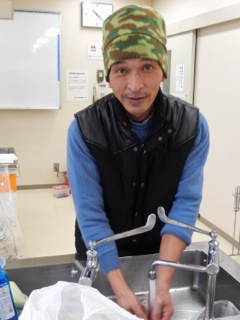
After the food was prepared, we volunteers ate a small lunch before heading upstairs for a meeting with the homeless participants. The men were told what services were to be offer for them this month. Of course, they could ask questions. Then we served the meal.


Yomawari was actually founded by three gentlemen: Imai Sensei, Aoki Sensei, and Shiyomi San. All three share responsibilities, but Imai Sensei is the most public, going for interviews and conferences, doing close work with government officials, and constantly pushing to collect funds, get food, and run programs such as showers and laundry service. Aoki Sensei is his right hand man and is with him always.

Shiyomi San runs the counseling branch of Yomawari. He helps with jobs, housing, and medical care. Each of these men is truly an angel in human form, as are the volunteers who offer their selfless service week after week.

Imai Sensei told me about a recent scandal concerning the homeless. Several companies had been recruiting these vulnerable gentlemen to clean up the Fukushima Nuclear Plant. Their job included a daily wage, dormitory space, and meals. The terms seemed good, so many men headed to Fukushima and gave their all, despite the dangers of the job.
It seems foreign journalist came to have a look at what was evolving at Fukushima. While there, they learned that the homeless men were being very badly exploited. The company bosses, Yakusa connected, had taken half the promised wages for themselves. In addition, they had charged for room and board. So at the end of the month, the hardworking homeless men had received no pay.
Reports of this abuse appeared in European newspapers. That, of course, caused an uproar. But here in Japan nothing at all appeared in the news. However, once the scandal was exposed, Imai Sensei was interviewed about it. He pointed out that many men had left Sendai with the promise of legitimate work. But since they had been cheated, they were now flocking back. That means Yomawari’s responsibilities have increased ten-fold as it tries to assist the influx of disillusioned men.


And the recipients were indeed grateful. Every one of them came to us after eating, and bowed very low. “Thank you,” they said. “Thank you for today’s warm meal. Thank you for your ongoing, loving care for us. Without you, where would we be?”
Love,
Anne
Watching the Progress
- At July 27, 2016
- By anneblog
- In Annes Letters
- 0
Dear Family and Friends,
In my most recent message to you, I talked about the organized Japanese mind. I mentioned long-term programs that were in place, in anticipation of the next natural disaster that would devastate one region or another of this beautiful archipelago.
By coincidence a few days after my letter to you, there was an article in the newspaper about a website the Tohoku University had posted. One department of that school is called IRIDeS, or the International Research Institute of Disaster Science. It has been tracking changes in this area since the life-altering events of March 11, 2011. And that is what this website is about.
http://michinoku.irides.tohoku.ac.jp/photovr/map.html

The next step is to click on the teeny picture. When you do that, a larger version of the same image appears on the right of the screen. Above that photo there is an arrow and a line. If you move the arrow from left to right, you will be able to see a progression of changes that have occurred since the initial damage. Some show only two: then and very recently. But others give a more detailed record of change, in some incidents as many as six or seven. What adds to the fascination is that the images do not jump from one to another, but rather evolve. That gives a sense of gradual change over time.

Of course, some areas were so devastated that there are many balloons piled on top of one other. In that case, it is impossible to click on any one of them. But not to worry. If you look to the left of the screen, you will see a small man. Below him is an indicator, which you can slide up or down to alter the size of the map. By increasing the size, the balloons separate, making it easier to click on each one.

Anne
UN Conference on Natural Disasters
- At July 27, 2016
- By anneblog
- In Annes Letters
- 0
January 2014
Dear Family and Friends,
There are many things I deeply admire about the Japanese. One of them is their long-term view of things. Coupled with that is their attitude that any goal can be achieved only by taking one small step at a time.
A perfect example of that, of course, is the recovery work here in Tohoku after the March 11, 2011 earthquake and tsunami. Literally hundreds of thousands of people have – and still are – contributing their efforts to get this area back on its feet. No one expects results overnight. Rather, they are thinking in terms of several generations; that is, thirty or forty years, or even longer.
A significant part of the recovery process includes more than Japan. This is reflected in the United Nation’s International Conference on Disaster Risk Reduction, to be held in Sendai in March 2015.

and his colleagues are taking careful measures to insure the event will be as inclusive as possible. Part of that is to make it be a community offering, not just a government responsibility. One aspect of that is to include students from local universities in the preparations and conference itself. So despite his heavy schedule as a government official, Hidetaka Yanatsu takes time to visit schools and to carefully explain his vision for the conference and students’ roles in it.
Miyagi University of Education (MUE) in Sendai is one place Hidetaka Yanatsu has targeted for assistance. After the March 11 tragedy, as an educational institution, MUE felt a tremendous responsibility to be of service, especially for children.

So the administration established a volunteer program. Even now, almost three years later, that group is still strong. Participants go to temporary housing complexes to give classes or hold special events. Now they are discussing ways of expanding their work to include help for survivors of Typhoon Haiyan in the Philippines.

MUE’s volunteers recently sponsored a week-long series of lectures aimed at discussing ongoing disaster issues. Hidetaka Yanatsu gave the opening speech. Of course, he talked about the UN conference next year. But his talk was much larger than that.

He also discussed many dimensions of emergency preparedness. He stressed that one of the most important ways to prepare is by networking and communication, not only in times of emergency, but also in daily life. Good communication builds up confidence and trust between people, so they can work better together in times of need. Of course, the Internet is invaluable for that. But Hidetaka Yanatsu went further. He explained how in the Tohoku area, which is basically rural, the strength of the community was one of the best sources of communication and of personal protection.


Hidetaka Yanatsu also added the dimension of role models. “We need leaders that we can look up to, of course,” he said. “Those should be not only government officials, but also ordinary people.” He suggested that this sense of leadership and unity among citizens should include individuals and local organizations, of course, and also universities, NPOs, and the army, to name a few.
He went on to say how a wide variety of media could also be very useful. And this should be done long before a catastrophe happened. He suggested art shows, classes in schools, and town meetings.


Students going to higher ground, as part of a tsunami drill
The point was to build up communication and trust so that when an emergency struck, people could immediately step into action. And in Japan the question is never “if”, but rather “when” there will be another major catastrophe.
Because of Japan’s ongoing natural disasters, relief measures have been in place for years. Relatively recently, the very damaging Hanshin Earthquake took place in Kobe in 2005. Kobe is located in the Hyogo area of Japan. So that major catastrophe lead to a ten-year relief program, called the Hyogo Framework of Action (HFA). Since the HFA program was firmly in place on March 11, 2011, the government was able to immediately implement relief efforts in Tohoku.

In other words, planning far in advance and working step-by-step are extremely helpful measures, especially in times of emergency.
Hidetaka Yanatsu concluded his informative speech by saying that although the Great East Japan Earthquake and Tsunami was far more devastating than anyone ever anticipated, and although it will take many, many years to reconstruct this area, we cannot stop making efforts. “We have to think long-term. We have to think even beyond Tohoku’s recovery. We have to ponder the long-term influence of the work being done now. And we must take small steps to achieve our goals. For example, we have to consider how the UN Conference on Disaster Risk Reduction will help other nations. We even should even think about how the Tokyo Olympics in 2020 will affect our future. We must think far ahead and plan accordingly.
“And it is crucial to look forward positively. That way we can create in our minds and in our daily lives the kind of future we want for our families, ourselves, our country, and the world.”

Anne
Planting Hope –OISCA
- At July 27, 2016
- By anneblog
- In Annes Letters
- 0
Dear Family and Friends,
My last letter portrayed the ongoing grief that pervades Fukushima. Even now that tragedy, along with so many others worldwide, tears at the world’s soul. However, life always seems to find a balance. And the other day a beautiful example of that unexpectedly crossed my path.
In Sendai Station a photo of a newly emerging pine tree caught my eye. Since I love photography and nature, I ventured into the small show to have a look. Before long I found myself completely mesmerized. It was not only because of the fine quality of the images, but also because of their hope-filled message.

To my delight I learned about a Japanese organization that devotes itself to recovery of land through environmentally sustainable development. That, of course, includes planting trees. This admirable endeavor is called OISCA, or to be precise, the Organization for Industrial, Spiritual, and Cultural Advancement. (1) Even though their headquarters are in Tokyo and even though they have projects all over the world, OISCA has come to Miyagi to help in our post-tsunami recovery.

But before going into the wonderful work of OISCA here, please let me digress with a bit of history. Sendai was founded over 400 years ago by a shrewd, but very wise, forward-looking daimyo named Masamune Date. He established many progressive programs for the betterment of this region. One that has endured over the centuries was the planting of a forest of black pine trees all along the coast of Miyagi. The winds in this northeast corridor can be fierce, as can the storms and waves. But having a belt of trees along the sea’s edge serves as a buffer against the fierce challenges of nature.

Because
OISCA is an organization that is on top of world events. So as soon as they realized the extent of the damage in Tohoku, they let the local government of Natori, a small city adjacent to Sendai, know it was available if they wished assistance. (2) OISCA never forces its way into an area. Likewise, it never tells people how to do things. Rather, they offer assistance, accept invitations, and work closely with locals.
“The people have to want us and to work closely with us. Otherwise we do not go to a region,” explained Toshimichi Yoshida San, the manager of this tree-planting project in Natori.
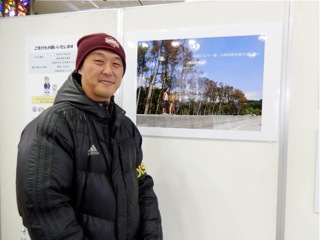
The Natori Coastal Forest Restoration Project is to run for ten years at the cost of a billion yen (about 10 million dollars) All the money is to come from donations. In this case all money will be entirely from within Japan. (3) “The reason is because of the paperwork involved. As it is, it is overwhelming,” explained Yoshida San with a sigh!
He continued by telling me that the Natori Project has three aspects. “One is tree planting, of course. That is the fun part. Many of the volunteers working with us lost their homes in the tsunami. So they are really eager to be part of this rebuilding. Then there is fund raising. That goes on and on. Finally there is all the organizing and coordinating. Those entail meeting after meeting, as we work to harmonize all aspects of the program. It is hard work, but we are coming along nicely.
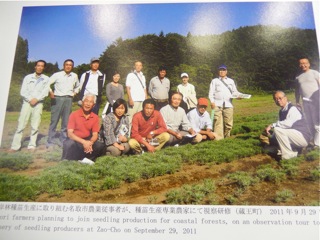
“When I started out, I knew nothing about black pines or about a program like this. But I did a LOT of research, interviewed hundreds of government officials, farmers, and other locals. I learned so much. Now we all trust each other, so we work well together.

“And we are pleased with how things are going. The first batch of baby tress is to be planted next spring. It is really very exciting. Of course, I won’t live to see the forest in its full glory. But my grandchildren and great-grandchildren surely will. Knowing that always helps to inspire and motivate me.
“And please be sure to join us next spring. Come as a volunteer and add your efforts to rebuild Miyagi. What you and so many others do will be appreciated for literally hundreds of years.”
Without any hesitation, of course I said I would. Who could not want to be part of such a beautiful, life-enhancing project that is so close to home?
(1) Each word of OISCA’s name has a special meaning, which relates closely to its mission. The following definitions are from the Internet. “Industrial” refers to “the promotion of agriculture and other primary industries that are fundamental to human existence.” “Spiritual” is an inner experience not connected to any outer religion. It includes “the need to nurture qualities such as self-reliance, dedication for one`s own community, international brother-sisterhood and respect for Earth`s ecological integrity on which life is grounded.” And finally “Cultural represents the intent to encourage the magnificent cultural diversity that has enriched human life and the universal need to promote cultural patterns such as culture of peace.”
For further information, please visit the OISCA website. It is in both Japanese and English
(2) They chose Natori because it was one of the hardest hit areas, suffering some of the greatest loss of trees
(3) OISCA’s international programs accept worldwide donations
A Visit to Fukushima
- At July 27, 2016
- By anneblog
- In Annes Letters
- 0
December 2013
Dear Family and Friends,
One of the positive things happening now in Sendai is all the reconstruction going on. The government has provided generous loans to rebuild, so old houses are being replaced by new ones. Also the entire sewer system is being renewed; and electric lines are being reinforced and more securely positioned. In other words, for most people, there is a very strong sense of hope and of moving forward.

But step out of Sendai and things start to change. In Miyagi and Iwate Prefectures much of the tsunami debris has been cleared, but recovery is slow. In fishing areas, for example, people are saying another thirty or more years will be needed to get things back to where they were, if ever. However, once the Trans-Pacific Partnership (TPP) comes into effect, this rural area of farmers and fishermen may never get back on its feet. But even so, in Miyagi and Iwate Prefectures building is going on continually. Roads are full of trucks plying back and forth.
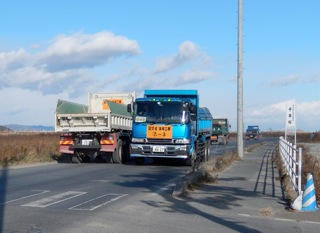
People are clearing the land of salt so planting can start again.
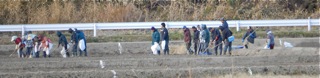
Small businesses are beginning to pop up along the main roads. And where people can, new homes are appearing. So a sense of progress, albeit slow, is being felt everywhere.
But Fukushima is another world entirely.
Minami Soma is a town just within the infamous twenty-kilometer radius of the Fukushima Nuclear Power Plant. Immediately after the meltdown, all townspeople were ordered to evacuate, taking only what they could carry with them. The place became off limits for anyone besides people working at the power plant. And they, of course, could only enter wearing enormous protective gear and were restricted as to how long they could stay in that diabolical zone.
The situation continued much the same for townspeople for over a year. Families were either put into temporary housing units or moved to other regions of Japan. Often several generations who had lived together as extended family were broken up and sent to differing places to live. In the meantime, the problems at the plant went from bad to worse, maybe a bit better, but then worse again. Even now, the dilemma remains formidable with no clear solution in sight.
Despite the ongoing nightmare, for some reason the radiation levels on the outer limits of the twenty-kilometer “No Entry” zone seem to have gone down. So about a year ago visiting restrictions were lifted for people who had homes there.
However, there was a further sad dimension of Minami Soma’s already tragic story. Once news got out about the town’s evacuation, organized crime came creeping in. Thieves arrived to loot whatever they could sell, knowing that things of great value had been left behind. The man who told me this said, “The greatest loss were the family altars. For us Japanese they hold the spirit of our ancestors, stretching back for centuries. We can lose furniture or heirloom kimonos, farm equipment or money, but to lose our Butsudan is to lose our souls.”

Finally the situation became so bad that armed guards were stationed around the whole area. Even now it has a reputation of being unsafe, not so much because of nuclear fallout, but because of disreputable, greedy human beings and what they might do. Because of that danger, people are allowed to be there only during daylight hours.
Besides residence, volunteers have recently come to the town to help clear up the mess that the tsunami left. Very touchingly several of them were young doctors doing internships in a nearby hospital.

They told me the illness they saw everyday were “the normal kind”, like colds and flu. They added that the people of the area were regularly checked for radiation, which always fell within acceptable levels. “Be sure to tell people this area is now safe. Some places with no nuclear problems have higher levels than are found here. It’s important for people to know that. Fukushima has such a sad reputation now, but it doesn’t have to be that way.”
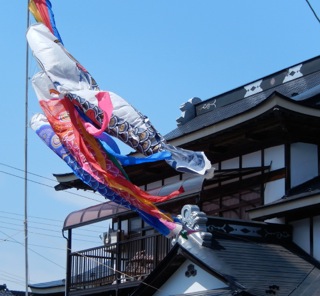
This volunteer clean-up work is starting up almost three years since the disaster. So going to that area is like stepping back in time. Buildings on the edge of town are still smashed up, abandoned cars dot the fields, curtains flap from broken windows, and even faded carp streamers of long ago still flutter in the breeze.


The town of Minami Soma itself was not hit by the tsunami, so houses are still in tact. At a cursory glance, it seems like a normal place, with maybe everyone inside for lunch. But as you stroll down the street, an eerie feeling begins to seep in. Then it dawns on you how much of a ghost town it has become. In fact, the atmosphere haunts with its deadly emptiness.

To add to the bizarre feeling, some things appear as if life were continuing normally. There is a line up of bicycles at the now-empty train station, for example. There are flowers and children’s toys outside homes, dish soap and hand cream left on widow sills. And then-new signs are boldly displayed in front of shops.

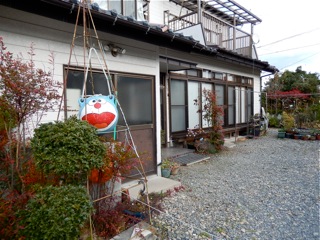

Of course, all of these images and feelings evoke profound questions. What future do the towns near the nuclear power station have? With all the economic problems the Japanese government and the Tokyo Electric Power Company have, will they be able to finance the tremendous cost of rebuilding those nuclear-devastated towns? Or will they turn their backs on the people, the land, and the problems, as they too struggle to move forward in these greatly precarious times?
Love,
Anne
Honor / Speak
- At July 27, 2016
- By anneblog
- In Annes Letters
- 0
Late November-Early December
Dear Family and Friends,
The news these days is always full of extreme contrasts, maybe more poignantly so this holiday time. Everywhere the abundance of this holiday season is juxtaposed with images of extreme deprivation, reflecting the widening gap of our time. Interestingly, a performance based on extreme contrasts came to Sendai the other day. As to be expected, its message and portrayal were very powerful indeed.
Actually many cultural shows and performances have come to Sendai and other areas of Tohoku since the disaster of March 11, 2011. Most are for sheer enjoyment, a way to ease people’s troubled minds and hearts. But recently there was a rather avant-garde drama that came from Aomori, a prefecture in Tohoku, but north of the devastated areas. This piece was in Japanese, Chinese, and Korean. Its title was “Iwau-Iu”, which means “Honor-Speak”.

This play emphasized extreme contrasts: darkness and light, closeness and separation, dream and reality. All the costumes were either black or white, with a single red scarf on one actress. The lighting was very subdued, with a suggestion of people’s outlines piercing the darkness.

The language kept switching from one that was recognizable to others there were both beautiful and unsettling sounds. Despite those fundamental differences, the conversations flowed smoothly, allowing perfect understanding between everyone involved. The audience, too, had a sense of fitting in and of comprehending through imagination and the heart. Of course, the message of unity and understanding was very poignant in this age of political uneasiness between the three Asian powers.

The story began with hopes and dreams, travel plans of friends, laughter. But then everything shifted dramatically with violence and total disorder. That upheaval ushered in the long, hard anguish of collecting and piecing together shattered lives and souls: a process going on to this day.
There was eerie, hauntingly slow music broken by violent burst of shocking sounds and flashing lights. That cacophony raged outward the inner anguish that people lived through and are still feeling deep within. The music was played on traditional stringed instruments from the triangle of countries involved. Those instruments were embellished by a piano and a male vocalist. Together they painfully birthed the innermost turmoil of the soul.

With destruction and confusion everywhere, people turned to each other and eventually to performance as a way to glue their world together again. But more important than a reflection of the journey we have all been on, this highly disturbing, but very beautiful drama was actually a gift of permission. It opened a door, turning the inner outward. It seemed to say, “It is all right to grieve. It is OK to still feel pain. You have permission to consciously work on the process of deep inner healing.” This is very difficult anywhere, but especially in a country where saving face is paramount.
The outer dimension is slowly becoming more stable. Gradually the physical world is being rebuilt and reshaped. But the inner wounding is still very much part of an ongoing, mostly unseen experience that most people hold close within. This drama clearly stated that the time has come to move the suffering outward. Not through violence or despair, but through art, creativity, and new life.
And indeed, this powerful performance ended with hope. A Japanese man was talking to a Chinese woman. They had been together before and during the earthquake and tsunami and were meeting once again. He told her he was now married and had a baby. “We live in Fukushima,” he said. “Please come and visit us in the future.” And her reply was, “Thank you. Of course, I will.”

Yomawari Hospitality
- At July 27, 2016
- By anneblog
- In Annes Letters
- 0
Dear Family and Friends,
Imai Sensei’s Yomawari Group is as busy as ever. I usually do not have time to volunteer with them, but today I was able to assist giving lunch to about forty homeless people. It was pouring rain, but even so we offered warm curry rice under an eave of the Sendai Welfare Plaza.
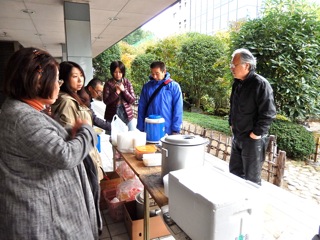
The Yomawari Group and the people they serve seem like a close-knit unit, almost a family. Among the volunteers, everyone has a role and does it well. I always have a few favorites who show up to help out. One lovely simple soul in particular touches my heart. He always shows up to socialize and help in any way he can.
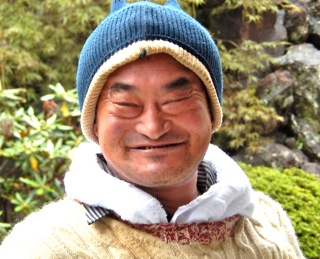
Another is a very proud man who delights in welcoming the homeless as graciously and politely as if he were ushering them into a tea ceremony.

He bows to each guest and greets him by name.
It is always a pleasure helping the Yomawari Group. Week after week, month after month, year after year – rain, snow, or shine – they are there to help the homeless of this community. They not only serve hot lunches (along with packaged food and clothes to take away), but also provide showers and laundry services. In addition they find cleaning jobs for the men, and offer counseling for finding housing and more stable work. Some of the volunteers now go to Fukushima to assist there as well.
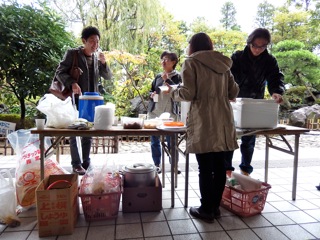
Yomawari Group serves hundreds of people and is always ready to help those in need. Yet it always stays very personal and deeply caring. Its mission is definitely “From the Ground to the Heart.”
Paddy in a Bucket
- At July 27, 2016
- By anneblog
- In Annes Letters
- 0
Autumn 2013
Dear Family and Friends,
Rice grown in the Tohoku area is particularly delicious. There are many varieties, each with its own special flavor and texture. In recent years, however, young folks have been flocking to cities for work, leaving mostly oldsters to run the farms. That, in addition to the devastation of coastal areas from the tsunami, plus the impending uplifting of tariffs on imported rice when the TPP comes fully into effect, rice growing in this region seems doomed. (However, it should be added that rice tariffs and TPP are still a hotly debated issue at this time.)
Despite the gloomy predictions about Japanese rice growing, there is an effort to keep the tradition alive. One way is that JA, “Japan Agriculture”, wants to encourage young people to grow Asia’s “gods’ grain” and to feel pride in their work. So, every year in autumn when the harvest is first coming in, there is a small “paddy in a bucket” event for locals with nearby farms.

Prior to this lovely, heart-filled event, each participant receives a blue bucket. Then on a designated day, in it they bring in their best specimen of paddy rice. In my neighborhood they meet outside the main supermarket. The organizers line up all the “bucket-paddies”, ranging from the most gorgeous to the most fragile specimens. There are always lots of farm kids there, too. So the people in charge make their instructive speeches short.

“Kids, and adults, too, see this rice here? Now why do you think this is the best we have today? . . . That’s right. The grains are full and abundant. And look how the stalks bend down so nicely. The field where this was grown must have had good soil, plenty of water, and just the right amount of sunshine.”
Then he moved on to the next bucket. “Now the one here looks great because of the nice green leaves. But if you look closely, you can see where a mite is eating the leaves. No good. This can spread and cause a lot of damage.”
He went to the next. “This one is a bit shabby. There are hardly any grains and the stalks are thin. Needs better water and sunlight.”
After his brief, but informative talk, the main organizer handed out certificates.

The first-prize winners got a kilo of new rice.

The next won a box of special Miyagi cakes. Third-prize got a bag full of leeks right off the farm.
Then it was time for a group photo. And of course, “Good luck getting through the winter ahead and see you next year.”

This event is fun because it is so delightfully low-key and local. But deeper than that, it encourages people to be proud of their farming roots and to stick with that tradition to help rebuild this area. And heaven knows, we surely do need that life-giving profession in these days of uncertainty and great change.
Love,
Anne
Charity Walk
- At July 27, 2016
- By anneblog
- In Annes Letters
- 0
October 2013
Dear Family and Friends,
Very recently, and completely by chance, I noticed a sign about a Charity Walk. It was to take place a few days hence, so I did not have a chance to sign up. But since I am interested in what is happening in this area, I went to check it out.
The start was at Sendai Airport. When I arrived at the early hour of 6:30, I was greeted by a man with a big smile and a sign indicating where to register.

Surprisingly, even at that early hour, almost all of the 300 participants had already assembled and were receiving a number.

The organizers were all from Aoba-ya, the company sponsoring the event. They wore bright green jackets and politely directed the participants to their designated groups. To start there were speeches, of course.
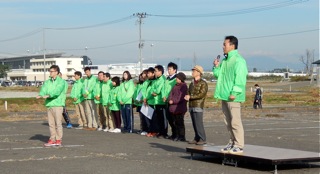

The participants came from near and far. Most were from Miyagi, but a few were from Tokyo and even as far away as Nagano. Ages ranged from the 20s to what appeared to be the 70s. One person was blind. One was a foreigner, an American.


One of the organizers told me Aoba-ya Company employees had walked the forty-kilometer course three months before. They wanted to be fully prepared before for sponsoring this meaningful charity event. Having walked it themselves, they knew exactly where rest stops should by, what drinks and snacks should be offered, and the importance of toilets. In fact, three portable ones followed along in vehicles just to be sure no one would be inconvenienced.
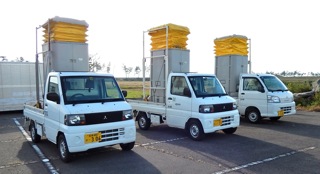
The participation fee was ¥10,000, or about $100. Half would go to setting up the walk and the rest to rebuilding efforts in Miyagi. This year the money would go to Ishinomaki, a fishing town north of Sendai. The company plans to hold a similar charity walk every year for ten years. This was the first.
The set off was warm with a smacking of hands for courage.

Even the old gentleman who started the company and his wife were there cheering people at the start.

It was very moving to see them and to think about what this company was doing for the area. It was also impressive to realize how they were thinking long term and willing to commit themselves to this event for the next ten years.
* * * * *
After I waved good-bye to the last participant, I turned my attention to the area around the airport. I had not been there for about a year, so wanted to explore. It was still very flat and empty, save one smashed building still standing. There were a few pine trees, too, alive but teetering at the same angle the tsunami had left them.
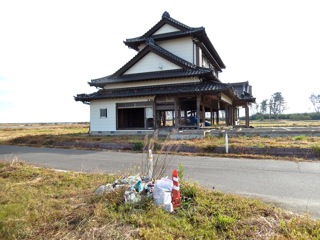
I wandered up to the seawall, still very much under construction. It seemed to stretch for miles. Behind it were long triangular tunnels made of logs. A worker explained that the coastline in that area would be raised several meters. The wooden frames were the foundation for that higher land. When finished, the reconstructed area would become an extensive memorial park. The work should take twenty years or more.


I wondered if I might have a shot of him and his wife this year, too. He beamed, but his wife ran to the truck pretending to be too shy. Actually, she was fixing her hair and pressing down her dress with her hands to be presentable for the photo.

They told me this would be the last year they could have their land. Then it would be swallowed up into the memorial park. “We’re still in temporary housing,” they informed me. “No fields there.”

(Temporary housing complex in Natori, outside Sendai)
“We used to have a big house right here. We all lived together. It was lively with all the grandchildren. We loved it. Now everyone is scattered all over the place. A few are in Sendai, but others are as far away as Tokyo.
“Times have changed,” they added with a sigh. “But that’s life, isn’t it? We’re lucky that we are all alive. And anyway, for the prefecture it’s good to be moving forward.” They paused and then added, “Yes, we have to think of what comes after us. That’s what makes today meaningful, even if in our personal lives we have lost so much.”
Philosophical farmers, new land, and a lovely charity walk: Miyagi deliberately and carefully evolving its way into a positive tomorrow.

Volunteering for Happy Hearts
- At July 27, 2016
- By anneblog
- In Annes Letters
- 0
Late August 2013
Dear Family and Friends,
When 9/11 hit in America, the whole world seemed to go into complete shock. Disbelief and panic were everywhere. I was in Japan at the time, and what impressed me immensely was how the government chose to handle the situation. Of course, the news was full of the drama and tragedy, but on another level the top priority was to keep people calm. I remember in particular the gentle classical music that was played in Sendai subway stations during that time. Usually we listened to rather peppy jazz, but not immediately after those terrorist acts that so rudely changed the world.
Since then, I have noticed a similar pattern repeated again and again here: the importance of calming the mental and emotional dimensions, no matter how dire the outer circumstances might be.


As I listened, I realized all the facts – which were confusing, unsure, and constantly changing – might not have been there. But the intent of the government and the scientists was to keep people calm. If the survivors, in fact the whole country, were not overwhelmed, but could think and act with equanimity, then all of us could more easily face the daunting tasks before us.

That attitude and those values have continued. Before the life-changing disaster, Sendai, and the Tohoku region in general, were considered rather a backwater area, a hick sort of place. But since the terrible destruction and ongoing economic slump here, things have started to change. Of course, clean up work and rebuilding have been going on for several years now, and will continue well into the future. But more than that, significant efforts are being made to keep our spirits from going under and to let us know we are respected and thought about. For example, there have been many top quality concerts and operas, with both Japanese and international conductors and orchestras that have come to this area. And art shows have included such treasures as paintings from the Louvre, artifacts from Peru, works of Vermeer, Van Gogh, and Chagall. Also American military families in Okinawa still have children from this area stay with them to enjoy a carefree week in the sun and surf. Those and many other acts of kindness and attention give all of us the energy and hope to move forward.
There are still thousands of people living in temporary housing. Psychologically, that situation is taking its toll as the residents are still between worlds. The old is lost, and a stable future has not yet materialized. Because of the nature of the situation, many volunteer groups, which initially were involved in clearing up, have shifted their focus to one of providing opportunities for joy and the release of stress. Most universities have volunteer programs, which students and members of the community can join. The activities offered range from cooking to yoga, from singing to dancing, from crafts to sports, from music to English.
These classes are meant to be fun, of course, but more than that, they help to build up a sense of community. That is vitally important in this collective culture. In many cases, people from differing areas were placed together in the same temporary housing complex. The adjustment of not knowing the person in the house next to you, after generations of living in the same place with the same families as neighbors, has been very difficult in this society with its long and deep roots of place. But ever so slowly trust is being forged, and new communities are being made.
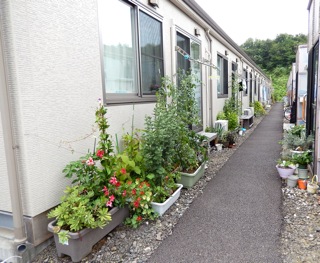
Recently, I had the privilege of visiting a temporary housing complex near Sendai. There are many such developments scattered throughout this region. I went to one called Medeshima Tobu. It had about 180 houses, all packed into close, tidy rows. There was not much space between them, but even so, people had planted flowers and laundry was hanging out.
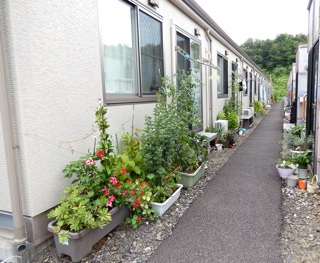
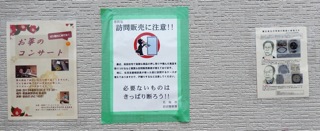

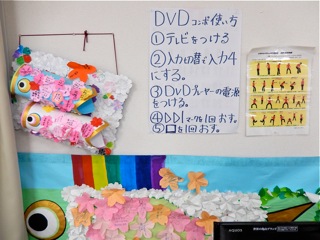
I went to Medeshima Tobu with Shokei University’s volunteer program. That day there was a yoga lesson, which was held in the small building designated as the community center. To let the residents know the activity was about to begin, volunteers walked among the houses with bullhorns calling people to join. Then we headed to the community center.

When I peered into the room, the first person I saw was a therapist giving an old woman a massage on the floor. Kenich Fujita Sensei frequently offered his much-appreciated services at that facility.

He gave a welcoming smile, so I walked in and found myself surrounded by older women eagerly waiting for their lesson. Slowly a few others drifted in. Then we began. The teacher, Kinuyo Kimura Sensei, was a professional yoga teacher who volunteered a few times a month at Medeshima, and at other complexes as well. She knew exactly what the residents needed, so had soft music with a rhythmic beat playing as we did stretching exercises for an hour and a half.

We did take a break for some tea and crackers. And laughter. The old women were so excited to have a foreign visitor that they circled me like cackling hens, roaring with laughter as they held out their hands and said, “Thank you,” or “Nice to meet you, “ or “I’m sorry.” Any expression they could muster up from their childhood English lessons about 70 years before. We all laughed and laughed and had a marvelous time.

I must say I left the facility feeling much lighter and happier. I hope the old women enjoyed themselves as much as I did. If so, and if the Japanese theory of a happy heart helping to bring success is true, then those ladies, and by extension their families, will have the courage to face whatever life has yet to give, wanted or not.
Love,
Anne
A Very Lucky Man
- At July 27, 2016
- By anneblog
- In Annes Letters
- 0
Dear Family and Friends,
Rie is one of my university students. One day when we were chatting, she began talking about her father. “I really admire him,” she said. “I’ve never seen someone work so hard as he has since the tsunami.” The more Rie talked about her father, the more I wanted to interview him.
The first thing Yoshinori Kikuchi San said to me was, “I am truly a lucky man.” And then his story began to unfold. He had had a large seafood packing and distributing company in Ishinomaki, Miyagi. It was directly near the sea, so not surprisingly, it was devastated on March 11, 2011.

“At the time of the earthquake, my wife and I were in Tokyo on business. Even down there the earth started shaking violently. We immediately switched on the radio and heard what was happening in Tohoku. I had never had any real experience with tsunami damage because there was a protective wall between our factory and the sea. But something inside said this one was going to be a whopper.
“My factory and family house were very close to one another. I had three daughters at home, so immediately I called them. Luckily, very luckily, I could get through. People calling locally in Tohoku could not get any connection, but we were in Tokyo, so we could. I told my daughters to get to high ground as fast as they could.
“Then I called the factory. I told the workers to open all the doors and then get as far away from the sea as possible. Opening the doors was important. That way the water could enter the building without much resistance. Then there might be a slim chance that the entire structure would not be destroyed. And it paid off. Water went up to the top floor, but the iron frame of the building held.

(The light brown line shows the tsunami water mark. It is on the second floor of the building)
“Again, I was lucky,” he continued. “I had gone to Tokyo by car. There were no buses, trains, or planes at that time, but I had a way to get home. Also very fortunately my car was a hybrid, so it did not need as much gasoline as an ordinary car. Later we recharged our phones and even cooked from it. Lucky!
“Of course, my wife and I were panicked, so we immediately hit the road. We were all right for a while, but as we got closer to Tohoku, the roads became clogged with cars. Everyone was trying to get home. It took us 27 hours of non-stop driving, but we made it.
“Our kids were our major concern. So we headed straight for the school where we thought they might be. There were well over a thousand people there, so finding them took a while. But finally we saw them. I’ll never forget that feeling of utter relief to see my girls – and our dog – all safe and with smiles. We ran into each other’s arms and held one another for a long time.

(Small sculpture in front of Ishinomaki Station)
“After resting a bit, my wife and I headed to where our home and factory had been. The army had already started to clear roads, so we could make our way through the rubble. Close to our factory I saw someone wearing my company’s uniform, so I knew he was one of our employees. He seemed dazed, overcome with disbelief. ‘It’s all gone, boss,’ he said almost in tears. Together we went to inspect the damage. Our factory was indeed a huge pile of broken dreams and shattered lives. I was overwhelmed. But I had people who depended on me. I simply could not collapse.
“Again, luck was with me. It came in the form of my wife. She and I had worked together for years. We both looked forward in the same direction. And during that terrible time we continued the supportive teamwork.

After about three days of stunned shock, she and I sat down and started planning. The first thing was to send the children to relatives. We were very fortunate to have family in another part of Tohoku. Many families all came from Ishinomaki, so had no relatives elsewhere. But my wife was from the Japan Sea area. They really helped us a lot. They took in our kids and supported us in every way they could. One way to thank them is to make my company a success again.
“We had four children and thirteen employees. We felt a tremendous duty to them, and also to our ancestors who started this company.

All those things really motivated us to act quickly. We did not think it was fair to apply for temporary housing; we were young and not handicapped. So we immediately rented an apartment.
“My wife and I started reading every document we could about how to apply for government compensation money and loans and how to rebuild a business. We were really on the ball, so were some of the first to get started moving forward. We built new buildings, bought new equipment, and tried to reconnect to former business partners.
“We couldn’t have done any of this without the help of the government. I really, really appreciate all it has done for us. It’s unbelievable. Do you realize they gave us compensation money that was three-fourths of what we needed? The other quarter was a twenty-year, interest-free loan. Can you believe that generosity? And on top of that, the schools where two of my daughters go gave us free tuition for a year or longer. Unbelievable. You can’t imagine the depth of my appreciation.


“Before 3/11 we shipped to a huge area, from as far north as Hokkaido, to as far south as Osaka. But now we can’t do that. First, as I said, the fish aren’t back to the levels of before. And also there aren’t enough boats. There aren’t enough people to shuck the oysters either. And people out of Tohoku are still very cautious about buying things from here. So now we serve the Tohoku and Kansai areas only. We are one of the only companies up and running, but even so, business is still only 25% of what it was before the disaster.

(As you can see, Mr. Kikuchi’s factory stands alone. There used to be many houses and factories surrounding it. Now there are only empty lots full of weeds.)
“I realize things may never get back to where they were before. And I feel a tremendous obligation to my family and workers. So my wife and I came up with the idea of asking a friend in the wholesale vegetable business if we could work together. Lucky for us, he agreed. So now I am learning a whole new type of business. One of the vegetables we deal in is edamame. We boil them up and package them in the teeny kitchen we now have. Then we send them out. They are really big in the Sendai area, one of the traditional foods there, so we sell down there. Business is not booming, but it is a start.
“When this vegetable business gets more solid, I am thinking of moving into solar energy. We’re putting it into the new house we are building, so we will be less dependent on the government for our electricity. There wasn’t any electricity for weeks after the disaster and we don’t want to be in that position again. And if we produce an excess, we can always sell it for a bit more income.
“Down the line, I’m thinking of meat. It’s illegal to have fish and meat in the same plant, so I’ll have to build a new place. And I’ll have to learn a lot, too. I am sure the rules and regulations are very different for meat than for seafood. But my wife and I will research and learn. We are constantly growing, and we won’t stop.
“We love Ishinomaki. This place is in our bones. So we can’t let our home turf down. We have to make a future, not only for us, but for this community as well. Luck has been with us from the beginning. And I trust it will continue. It is all about attitude. I focus very intently on making each day be positive. I plan. I work hard. But I also know I have been blessed with very good luck every step of the way.”

Love,
Anne
Soup Run, July 2013
- At July 27, 2016
- By anneblog
- In Annes Letters
- 0
July 23, 2013
Dear Family and Friends,
It has been quite a while since I volunteered at one of Imai Sensei’s “soup runs” for the homeless. But the other day I had the time, so eagerly went to help out. This time it was held in a park. Despite the inclement weather, people started gathering about an hour before. Then volunteers began drifting in. And at exactly 11:30 vans arrived with food, freshly cooked and steaming hot.
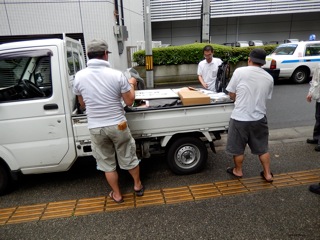
We volunteers hurried to set things up, as the rain graciously backed off — amazingly from start to finish.

This week there were several first-year high school students with their teacher. They were allowed to dish out the rice and beef curry stew,
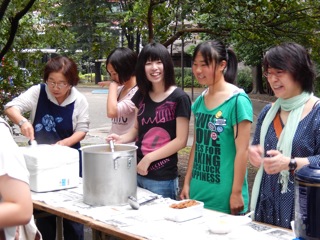
while the rest of us handed out items for the men to take with them: shoes, compressed gas cans for their cookers, rice, cans of spam, and packages of instant soup. One man was in charge of getting medications for men who needed them, so he took orders to give out the following week.

Yomarari Group has been at this “soup run” for so long that things now run without a hitch. Since it was so wet today, for example, they had brought large pieces of cardboard for the men to sit on. And they knew of a drinking fountain drain where we could squeeze out excess juices from bags of pickles before putting them into Styrofoam bowels on the serving table.
Today there were old timers and new comers, young and aged. Imai Sensei told me lots of people were still coming from far away, looking for work. As a consequence, companies have been hiring for only short periods. When new people arrive, older ones get laid off. New ones are cheaper, so the companies take advantage of that. That means many men are left without enough money to move on. So, they join the weekly “soup run” and become part of the Yomawari “family.”
“My work is never ending,” said Imai Sensei. “We do what we can. But the depressed economic situation here is really tough.”
The men could get seconds, if they wished, but not too much for fear gorging would make them sick. All of them did come back for more. And as usual they were incredibly polite and grateful.
After the homeless guests had finished, we volunteers were allowed to eat. I sat next to one man, who started to philosophize. “You know, I was raised a Buddhist, so I learned to believe in reincarnation. If you are out of luck in this life, then maybe in another things will be better. And the other way, too. But in Christianity© the perspective is really different. You have this one life, and then you go on to the next, probably for eternity. That concept really gives a sense of urgency. You’ve got to get it right this time round. That’s why I volunteer here. Not for me, but for these guys. I want to help them in every way I can, so that in this life, the only one they have, they will know some beauty, some hope, and maybe some love.”
Later Imai Sensei asked the high school girls their impression. “I learned a lot.” “I didn’t know there were so many homeless in Sendai.” “I was surprised by how gentle these men were.”
“Yes,” said Imai Sensei. “Remember. These men are human beings, just like you and me. But they’ve had bad luck. This could happen to you or to anyone. So, remember to always keep an open mind and see the humanity in everyone, no matter what.”
And with those words implanted in our hearts, we all bowed deeply to one another, and went our various ways.
© (Imai Sensei is a Baptist preacher, who believes it is his Christian duty to combine his religious beliefs with work in the world. Yomawari Group is the outcome.)


